

TL;DR:
- Understanding visa requirements and destination-specific coverage needs is crucial to avoid costly mistakes.
- Choosing geographic coverage wisely balances cost with adequate protection during unexpected travels.
- Reviewing policy details, exclusions, and verification factors ensures practical protection and compliance.
Choosing the right international health insurance as an expatriate is genuinely difficult. The plans are complex, the stakes are high, and a single oversight can leave you facing enormous medical bills or even a rejected visa application. Many expats make costly mistakes simply because they don’t know what to look for or who to trust. The good news is that a structured approach removes the guesswork entirely. This guide walks you through each critical step, from understanding visa prerequisites to verifying real-world compliance, so you can protect yourself and your family with confidence.
Table of Contents
- Identifying expat insurance prerequisites
- Choosing the right coverage geography
- Assessing policy details and exclusions
- Verifying compliance, billing and real-world protection
- Why traditional advice misses crucial gaps in expat insurance
- Explore top expat insurance solutions and expert resources
- Frequently asked questions
Key Takeaways
| Point | Details |
|---|---|
| Visa compliance is critical | Failure to meet local insurance requirements can jeopardise your residency or work authorisation. |
| US coverage raises costs | Including US healthcare in your policy increases premiums by up to 50%; exclude it if not needed. |
| Scrutinise policy exclusions | Always check for limits around pre-existing conditions, chronic illnesses, and emergency evacuation. |
| Avoid price-only mistakes | Choosing solely based on price risks gaps in emergency and compliance cover. |
| Demand real-world protection | Look for direct billing, hospital networks, and evidence of strong service for expats. |
Identifying expat insurance prerequisites
Before you can select the right plan, it’s crucial to understand exactly what you’ll need as an expatriate. Getting this foundation right saves you from expensive surprises later.
The first thing to recognise is that many countries require minimum coverage for residency or work visas. This isn’t optional. Germany, Spain, and most Schengen-area nations specify minimum benefit levels, and submitting an inadequate policy can result in a visa refusal. Before comparing plans, research the exact requirements for your destination country through its official embassy or consulate.
The second major decision is whether your plan needs to include the United States. If you live or work in the US, or plan to travel there regularly, you need US-inclusive cover. However, USA-inclusive plans cost 30-50% more than equivalent worldwide plans that exclude the US. This is a significant budget factor. If you’re based in Asia or Europe and rarely visit America, excluding US coverage is one of the most sensible cost-saving decisions you can make.
Here’s a quick overview of common prerequisites by region:
| Requirement | Europe/Schengen | Asia Pacific | Latin America |
|---|---|---|---|
| Minimum coverage amount | Often €30,000+ | Varies by country | Varies by country |
| Emergency evacuation | Usually required | Recommended | Recommended |
| Visa-linked compliance | Strictly enforced | Sometimes required | Rarely required |
| Direct billing preferred | Yes | Yes | Less common |
Expats also frequently make the following mistakes when assessing prerequisites:
- Choosing a plan purely because it has the lowest premium
- Overlooking emergency evacuation and repatriation benefits
- Failing to check whether the policy covers their entire period of stay
- Ignoring outpatient and dental cover requirements
Pro Tip: Before you request a single quote, write down your visa type, destination country, planned travel regions, and any known health conditions. This list becomes your non-negotiable checklist when comparing policies. You can also review expat medical basics to make sure nothing is overlooked.
Understanding your prerequisites takes perhaps an hour of research. Skipping it can cost you thousands.
Choosing the right coverage geography
Once you’ve clarified your basic requirements, the next step is selecting the geographic scope of your insurance. This single decision shapes your premium, your protection, and your peace of mind.
There are three standard options available to most expats:
- Worldwide including the USA: The broadest and most expensive option. Essential if you travel to or reside in America.
- Worldwide excluding the USA: Covers most of the globe at a considerably lower premium. Sensible for expats based in Europe, Asia, or Africa.
- Regional coverage: Limited to a specific area, such as Europe or South-East Asia. The most affordable option, but risky if your travel plans change.
To illustrate why geography matters so much, consider that a single ICU day in the United States costs between $3,800 and $4,200 on average. One unexpected medical emergency during a business trip to New York could generate a bill that exceeds your annual premium many times over. This is why USA coverage increases premiums by 30 to 50% but also why excluding it without careful thought is a genuine risk.
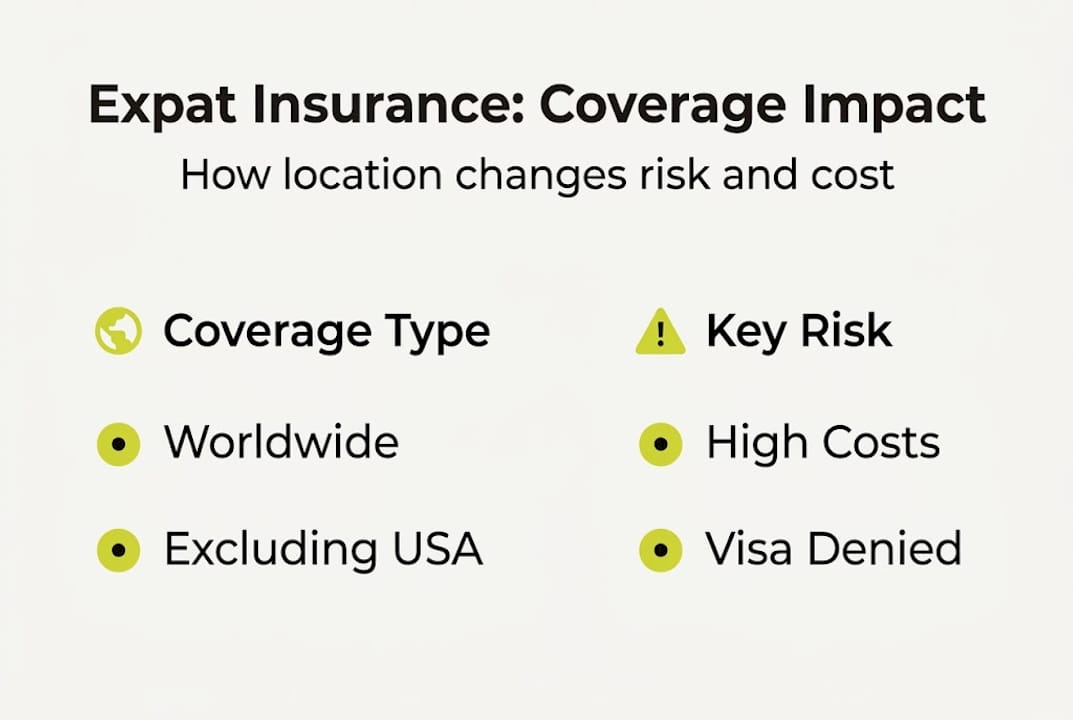
Use this comparison to guide your thinking:
| Coverage type | Best for | Approximate premium impact | Key risk |
|---|---|---|---|
| Worldwide incl. USA | US residents, frequent US travellers | Highest | None if US travel is regular |
| Worldwide excl. USA | Europe/Asia-based expats | Moderate | Gap if US travel increases |
| Regional only | Fixed-location expats | Lowest | No cover outside region |
When comparing expat health plans, pay close attention to what happens if you travel outside your covered region unexpectedly. Some plans offer limited emergency cover during short trips outside the region, whilst others provide nothing at all. This is a common trap for expats who choose regional cover and then find themselves on an unplanned trip.
For those who travel frequently across multiple continents, worldwide excluding USA is typically the sweet spot. It provides broad protection whilst keeping costs manageable. If you’re unsure, securing care abroad starts with matching your geography to your realistic travel behaviour, not your ideal scenario.
Key insight: Review your last 12 months of travel. If the US didn’t appear once, excluding it is almost certainly the right financial decision. If it appeared even twice, the cost of US-inclusive cover is likely justified.
Assessing policy details and exclusions
After setting the geographic scope, it’s time to examine the finer details of your chosen insurance plans. This is where most expats lose ground, because the differences between plans are often buried in the small print.

Pre-existing conditions are the most common source of dispute. Insurers handle these in two main ways. Full medical underwriting (FMU) means you disclose all health history upfront, and the insurer decides what to cover before you purchase the policy. Moratorium underwriting is more automatic: a 24-month moratorium period means you must be symptom-free and treatment-free for two years before a pre-existing condition becomes eligible for cover. Chronic conditions are almost always excluded permanently under moratorium policies.
Here is a practical checklist for reviewing policy details:
- Confirm exactly which pre-existing conditions are excluded and under what terms
- Check whether mental health cover is included or requires a paid add-on
- Verify that emergency evacuation and repatriation benefits meet your destination’s visa requirements
- Review annual limits and any per-condition sub-limits that may cap your protection
- Confirm whether telemedicine is available, particularly useful in countries with limited English-speaking doctors
- Check the outpatient cover structure, as some plans exclude GP visits unless an add-on is purchased
For retirees, digital nomads, and those managing chronic conditions, the policy details matter even more than the headline premium. A retiree with managed hypertension, for instance, may be completely uninsured for any cardiovascular event under a moratorium policy if the condition was active within the past two years.
Pro Tip: Always request the full policy wording before you purchase, not just the benefits summary. The summary highlights what’s included; the wording reveals what’s excluded. Reading types of expat health cover side by side with the policy document is a practical way to spot gaps.
“The most common mistake expats make is assuming that a plan which covers hospitalisation automatically covers everything they need. It rarely does.”
Reviewing top international plans explained can help you understand how leading insurers structure these details so you know what reasonable looks like.
Verifying compliance, billing and real-world protection
Finally, even a plan that looks comprehensive on paper needs to be checked for compliance and practical performance. A policy that fails at the point of care is no policy at all.
Start with a focused compliance and practicality checklist:
- Does the policy satisfy visa requirements for your specific destination?
- Is emergency medical evacuation included, with a clearly stated benefit limit?
- Does the insurer offer direct billing with hospitals in your area? Without it, you pay upfront and reclaim later, which can mean managing large sums out of pocket during a medical crisis.
- Are there any waiting periods before certain benefits activate?
- Does the insurer have a 24-hour emergency helpline that operates in your local time zone?
The statistics on this topic are sobering. 41% of expats discover gaps in their coverage only when they face a real emergency. That figure represents nearly half of all internationally mobile professionals who believed they were protected and weren’t.
| Verification check | Why it matters | How to confirm |
|---|---|---|
| Visa compliance | Avoid rejection or legal issues | Compare policy to embassy requirements |
| Emergency evacuation | Critical in remote locations | Check policy wording for limits |
| Direct billing network | Avoid large upfront costs | Request hospital list from insurer |
| 24-hour helpline | Essential during emergencies | Test the number before you travel |
“Price is the starting point of the conversation, not the ending point. A cheaper plan that fails compliance or lacks direct billing costs far more in the long run.”
For further guidance on protecting your wellness abroad, prioritise insurers with established hospital networks in your destination country. You can also review real-world medical plan examples to see how these verification steps apply in practice.
Why traditional advice misses crucial gaps in expat insurance
Here is the uncomfortable truth that most mainstream guidance skips: the conventional approach to choosing expat insurance still centres almost entirely on premium comparison. Brokers present a table of costs, highlight a mid-range option, and move on. The deeper questions about disclosure obligations, moratorium timing, visa-specific compliance, and direct billing rarely come up until something goes wrong.
We’ve seen this pattern repeatedly. An expat purchases a well-reviewed plan at a reasonable price, then discovers during a hospital visit that their condition falls under an exclusion nobody explained clearly. The policy technically complied with their visa requirements but failed them at the moment it mattered most.
The solution is to demand rigour before you sign. Ask specific questions about your health history. Insist on the full policy wording. Test the emergency helpline. Treat expat medical insurance basics not as a checklist to rush through but as a framework for real protection. Advice that doesn’t address these realities isn’t advice. It’s guesswork dressed in professional language.
Explore top expat insurance solutions and expert resources
If this guide has helped you see how many layers a solid expat insurance decision really involves, you’re already better prepared than most. Taking the next step means moving from research to action with the right support behind you.
At Unparalleled Global Benefits, we connect expat professionals and families with carefully reviewed plans that address the real-world complexities covered in this guide. Whether you need to choose an expat insurance provider that meets visa requirements, or want to compare leading options through our expat insurance comparison resource, we make the process straightforward. You can also browse our vetted top insurers directory to find providers with strong direct billing networks and genuine emergency support.
Frequently asked questions
Which countries require minimum health cover for expat visas?
Most European and Asian countries set minimum insurance requirements for residency or work visas. Always check local embassy guidelines, as many countries require minimum coverage and specific benefit structures before approving your application.
Is US health insurance coverage always needed for expats?
US-inclusive plans are essential only if you live, work, or travel in America. Excluding the US can reduce your premium by up to 50%, since USA-inclusive plans cost 30-50% more than comparable worldwide plans.
How do insurers handle pre-existing conditions for expats?
Insurers typically use either full medical underwriting or a moratorium approach. Under moratorium underwriting, a 24-month symptom-free period is required before a pre-existing condition becomes eligible, and chronic conditions are usually excluded entirely.
What happens if my insurer doesn’t offer direct billing?
Without direct billing, you pay all medical costs upfront and then submit a claim for reimbursement. Always confirm local hospital networks before purchasing a policy, as the absence of direct billing can create serious financial strain during a medical emergency.
Recommended
- How to Read an Insurance Policy: A Simple Guide for Expats
- Understanding expat insurance: benefits, cover, and what you need – Unparalleled Global Benefits
- How to choose expat insurance: global peace of mind – Unparalleled Global Benefits
- Why expats need insurance: Safeguard your life abroad – Unparalleled Global Benefits
- Stuff Happens … Are You Covered? | Mortgage Managers