
TL;DR:
- Travel health plans often do not cover emergencies abroad, risking huge out-of-pocket costs.
- Assess your current coverage, activities, and medical history before choosing a policy with adequate limits.
- Prepare documentation, emergency contacts, and a travel health kit to ensure quick access to help.
Imagine landing in Bangkok or Buenos Aires, falling seriously ill, and discovering your home health plan covers nothing. No reimbursement, no network, no support. This situation is far more common than most travellers expect, and many domestic plans provide no meaningful protection once you cross your home country’s border. The good news is that a structured checklist can close every gap before you board your flight. This guide walks you through evaluating your current cover, selecting the right policy, and organising everything you need to stay protected from the moment you depart to the moment you return.
Table of Contents
- Why do you need travel medical coverage?
- Checklist: What to assess before you buy coverage
- Selecting the right policy: Essentials for global health safety
- Final preparation: Documentation, contacts, and emergency planning
- Why most travellers overlook the real risks—and how to truly protect yourself
- Take the next step: Secure the best global health coverage
- Frequently asked questions
Key Takeaways
| Point | Details |
|---|---|
| Check current insurance | Most domestic policies do not cover you abroad, so review exclusions carefully. |
| Prioritise evacuation cover | Medical evacuation costs can exceed £80,000, so ensure your policy includes robust limits. |
| Prepare documents and kit | Carry insurance details, emergency contacts, prescriptions, and a personal health kit whenever you travel. |
| Understand key exclusions | Adventure sports and pre-existing conditions need special coverage—always read the fine print. |
Why do you need travel medical coverage?
Travel is one of life’s great pleasures, but it carries real health risks that most people underestimate until something goes wrong. Whether you are hiking in Peru, attending a conference in Tokyo, or visiting family in Lagos, your body does not take a holiday from illness or injury. The question is not whether something could happen. It is whether you are financially and logistically prepared if it does.
Most domestic health insurance plans offer no protection or severely limited benefits when you are overseas. This means a broken leg in Italy or a cardiac event in Japan could result in enormous bills paid entirely out of your own pocket. Understanding the difference between health vs travel insurance is the first step towards making an informed decision.
The financial stakes are genuinely alarming. Medical evacuation costs can exceed $100,000, and that figure does not include the underlying treatment costs. A single night in a private hospital in the United States or Switzerland can run into tens of thousands of dollars. Without adequate cover, one medical emergency can wipe out years of savings.
Here are the top medical risks that travellers face abroad:
- Acute illness, including food poisoning, respiratory infections, and tropical diseases
- Accidents and injuries from road traffic, adventure activities, or simple falls
- Chronic condition flare-ups that require urgent specialist care
- Emergency medical evacuation to a facility capable of treating your condition
- Repatriation to return home for ongoing care or, in the worst cases, for remains
“The single most overlooked risk in international travel is not theft or flight delays. It is the assumption that your existing health cover will simply work abroad. It usually does not.”
Getting pre-travel insurance in place before departure is not a luxury. It is a fundamental part of responsible travel planning, as essential as your passport.
Checklist: What to assess before you buy coverage
Before you compare policies or request a quote, you need to audit your current situation. Rushing into a purchase without this groundwork often leads to gaps, duplicate cover, or policies that simply do not suit your needs.
Follow these steps before committing to any plan:
- Review your existing health plan. Contact your insurer and ask specifically whether your policy covers emergency medical treatment abroad, hospitalisation, and evacuation. Get the answer in writing.
- Note your travel details. Record your destination countries, trip duration, planned activities, and whether you will be travelling solo or with dependants.
- List any pre-existing conditions. Conditions such as diabetes, heart disease, or asthma require specific attention. Many standard policies exclude these unless you purchase a waiver. Read more on travel insurance for medical conditions.
- Identify your activity profile. If you plan to ski, scuba dive, or rock climb, standard policies may exclude injuries from these activities. Check whether you need adventure insurance cover.
- Gather key questions for insurers. Before you buy, ask about coverage area, network providers, deductibles, and direct billing.
Use this comparison table to evaluate plans side by side:
| Feature | Primary coverage | Secondary coverage |
|---|---|---|
| Pays first, regardless of other plans | Yes | No |
| Requires coordination with home insurer | No | Yes |
| Direct billing to hospital | Often available | Less common |
| Reimbursement model | Less common | Standard |
| Best for travellers without home cover | Yes | No |
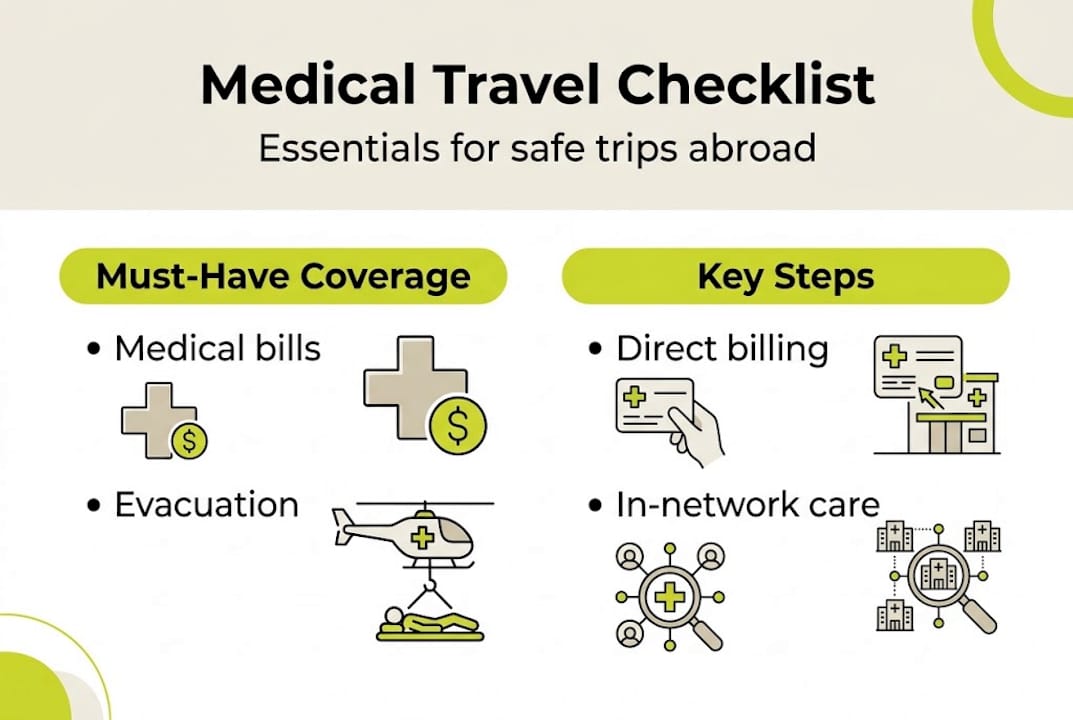
Pro Tip: Always opt for direct billing where possible. This means the insurer pays the hospital directly, so you are not left fronting thousands of pounds and waiting weeks for reimbursement. Pair this with a high evacuation limit and you have a genuinely robust safety net.
Selecting the right policy: Essentials for global health safety
With your checklist complete, you are ready to make a real decision. Not all policies are equal, and the differences between them can be the difference between full protection and a very expensive surprise.
As a baseline, purchase supplemental travel health insurance that covers emergency medical care, hospitalisation, and evacuation. We recommend a minimum of $250,000 in medical cover and $500,000 for medical evacuation. These figures may sound high, but a single air ambulance transfer across continents can consume that budget entirely.
Always confirm whether your destination’s hospitals are in-network with your insurer. Out-of-network treatment in private facilities can cost significantly more, and some insurers will only reimburse at in-network rates regardless of where you were treated.

Here is a summary of common exclusions and the riders available to address them:
| Exclusion | What it means | Rider or solution |
|---|---|---|
| Pre-existing conditions | Conditions diagnosed before purchase | Pre-existing condition waiver |
| Adventure sports | Injuries from skiing, diving, climbing | Adventure sports rider |
| Age limits | Cover capped at a certain age | Senior travel policy |
| Visa requirements | Some visas require proof of cover | Visa-compliant policy |
| Mental health treatment | Often excluded from basic plans | Mental health rider |
For travellers with ongoing health issues, insurance for health conditions is a specialised area worth exploring carefully. Standard policies are often not designed with these travellers in mind.
Key features to look for in any policy:
- Emergency medical and hospitalisation cover at a meaningful limit
- Medical evacuation and repatriation with at least $500,000 cover
- 24/7 emergency assistance with a multilingual helpline
- Direct billing to hospitals and clinics in your destination
- Pre-existing condition waivers if relevant to your health profile
Pro Tip: Always choose primary coverage over secondary coverage if you can. Secondary cover only pays after your home insurer has contributed, which creates delays and administrative friction precisely when you need fast support.
Also note that many plans exclude adventure sports and pre-existing conditions unless a rider is explicitly added. Read the exclusions section of any policy before signing, not after.
Final preparation: Documentation, contacts, and emergency planning
Buying the right policy is only half the job. The other half is making sure you can actually use it when you need it most. Preparation here is practical and straightforward, but it requires deliberate action before you leave home.
Always carry your insurance policy card, claim forms, and provider contact details. In many countries, you will be expected to pay upfront and claim reimbursement later. Knowing this in advance prevents panic at the billing desk.
Follow these steps to prepare your documentation:
- Print and store your policy documents. Keep both a physical copy in your luggage and a digital copy in your email or cloud storage.
- Save your insurer’s emergency number. Store it in your phone under a clearly labelled contact such as “Travel Insurance Emergency.”
- Note your nearest embassy or consulate. They can assist in locating reputable medical facilities and may help in extreme emergencies.
- Identify hospitals at your destination. Research accredited facilities in advance using resources such as the Joint Commission International directory.
- File claims promptly. Most policies require claims within 30 to 90 days of treatment. Keep every receipt, invoice, and medical report.
For your travel health kit, pack prescription medication, essential over-the-counter remedies, your insurance card, and an allergy summary. A written medical summary is invaluable if you are treated by a clinician who does not speak your language.
Essential items for your travel health kit:
- Sufficient prescription medication for the entire trip, plus a few extra days
- Over-the-counter remedies for common issues such as diarrhoea, fever, and pain
- Written allergy and medical history summary
- Insurance card and emergency contact numbers
- Copies of any specialist letters or recent test results
“In a medical emergency abroad, the first 30 minutes matter enormously. Knowing your insurer’s number and your nearest accredited hospital before you need them is what separates a manageable crisis from a devastating one.”
Understanding your options for emergency medical evacuation and how medical evacuation insurance works in practice will give you confidence that you are genuinely covered, not just technically insured.
Why most travellers overlook the real risks—and how to truly protect yourself
Here is what we see repeatedly: travellers spend hours comparing flight prices and accommodation, then spend ten minutes skimming a travel insurance summary before clicking “buy.” The result is a policy full of exclusions they never read and an evacuation limit that would not cover half the actual cost.
The uncomfortable truth is that most people treat travel insurance as a formality rather than a tool. They assume their base health plan covers them, or that emergencies only happen to other people. Then the bill arrives.
The details that matter most are rarely highlighted in marketing materials. Low evacuation limits, reimbursement-only models, and vague pre-existing condition clauses are buried in the fine print. Understanding the importance of evacuation cover is something most travellers only appreciate after a close call.
Pro Tip: Read the exclusions section of any policy before you read the benefits. What a policy does not cover is almost always more important than what it does.
Treat your travel medical cover as a non-negotiable part of your travel budget, not an optional add-on. The cost of a solid policy is a fraction of one night in a foreign hospital.
Take the next step: Secure the best global health coverage
You now have a clear picture of what travel medical cover requires and how to secure it properly. The next step is finding the right plan for your specific situation.
At Unparalleled Global Benefits, we specialise in international insurance solutions for travellers, expats, students, and families. Whether you need a single-trip policy or long-term cover, our travel health insurance guidance will help you understand your options clearly. Explore our international health insurance explained resource for a broader view of what global cover involves, or browse our top global insurers to compare leading providers. Request a quote today and travel with genuine peace of mind.
Frequently asked questions
Does my home health insurance cover me abroad?
Most home health insurance plans do not cover medical costs overseas, so dedicated travel medical cover is essential before any international trip.
How much medical evacuation cover do I need?
A policy should provide at least $250,000 for medical care and $500,000 for medical evacuation to ensure you are adequately protected in most scenarios.
What should I carry in my travel health kit?
Pack extra prescription medication, essential over-the-counter medicines, your insurance card, and a written allergy and medical summary in case you need treatment abroad.
Are adventure sports and pre-existing conditions usually covered?
Many plans exclude adventure sports and pre-existing conditions from standard cover; request specific riders or waivers when purchasing your policy to ensure these are included.
Recommended
- Travel health insurance guide: secure medical cover abroad – Unparalleled Global Benefits
- 7 pasos clave en checklist de salud para viajar al extranjero – Unparalleled Global Benefits
- 7 Essentials for Best Long Term Travel Insurance Abroad – Unparalleled Global Benefits
- How to Get Medical Insurance Abroad: Your Essential Guide for Expats and Travelers
- Warum Reiseversicherungen für Disneyreisen unverzichtbar sind – 2000-reisen