

TL;DR:
- Accurate, compliant medical insurance is essential to avoid visa rejection, deportation, or bans.
- Requirements vary by country and visa type, demanding specific coverage amounts and approved insurers.
- Long-term stays often require expat medical policies, while short trips may suffice with travel insurance.
Assuming any health insurance policy will satisfy your visa application is one of the most common and costly mistakes applicants make. Embassies and consulates scrutinise proof of medical cover more carefully than ever, and a policy that falls even slightly short of the required standard can result in outright rejection. Different countries have entirely different rules, minimum coverage amounts, approved insurer lists, and mandatory clauses around repatriation and emergency care. Generic travel insurance bought at the last minute rarely meets these standards. This guide breaks down exactly what medical insurance you need, country by country and visa type by visa type, so your application stands on solid ground.
Table of Contents
- Understanding why visas require medical insurance
- Country-specific medical insurance rules for visas
- Choosing the right policy: travel insurance versus expat medical cover
- Common pitfalls and expert tips for securing compliant cover
- Why strict insurance rules often save travellers more than they think
- Find trusted insurance for your visa application
- Frequently asked questions
Key Takeaways
| Point | Details |
|---|---|
| Visa insurance rules differ | Each country has its own requirements for medical insurance; generic plans often do not suffice. |
| Document compliance is crucial | Providing the correct policy documents and proof of purchase is essential for visa approval. |
| Short-term vs. expat insurance | Travel insurance suits short stays, while expat health cover or IPMI is needed for long-term visas. |
| Common pitfalls can delay visas | Errors like insufficient coverage, high deductibles, or incomplete documents may lead to rejection. |
| Investing in robust cover saves | Compliant insurance protects your finances, even where not strictly required by law. |
Understanding why visas require medical insurance
Countries do not require medical insurance for visas out of bureaucratic habit. There is a clear financial and logistical rationale behind every rule. When a visa holder falls ill or is injured abroad, unpaid hospital bills frequently fall to the host country’s public health system. Governments protect their healthcare budgets by making insurance a condition of entry.
For you as an applicant, the stakes are equally high. Without compliant cover, you risk more than a rejected application. You could face deportation, early termination of your programme, or a ban on future applications. These are not theoretical outcomes. US J-1/J-2 exchange visas require a minimum of $100,000 medical coverage per incident, and the rules are strictly enforced. A lapse in coverage, even for a few days, can trigger programme termination.
The most common consequences of non-compliant or absent insurance include:
- Visa application denial at the consulate stage
- Cancellation of a student or exchange programme mid-stay
- Deportation or refusal of re-entry
- Personal liability for medical bills running into tens of thousands
- Difficulty obtaining future visas due to a compliance record
Understanding the visa insurance global requirements that apply to your destination is not optional. It is the foundation of a successful application.
“Visa holders should treat insurance compliance with the same seriousness as their passport validity. A lapse in either can end your stay immediately.”
Even short gaps in coverage, such as a policy that starts one day after your visa activation date, can be flagged and penalised. Precision matters here.
Country-specific medical insurance rules for visas
Once you understand why these rules exist, the next step is knowing exactly what your target country demands. Requirements vary significantly, and what works for one destination will not automatically satisfy another.
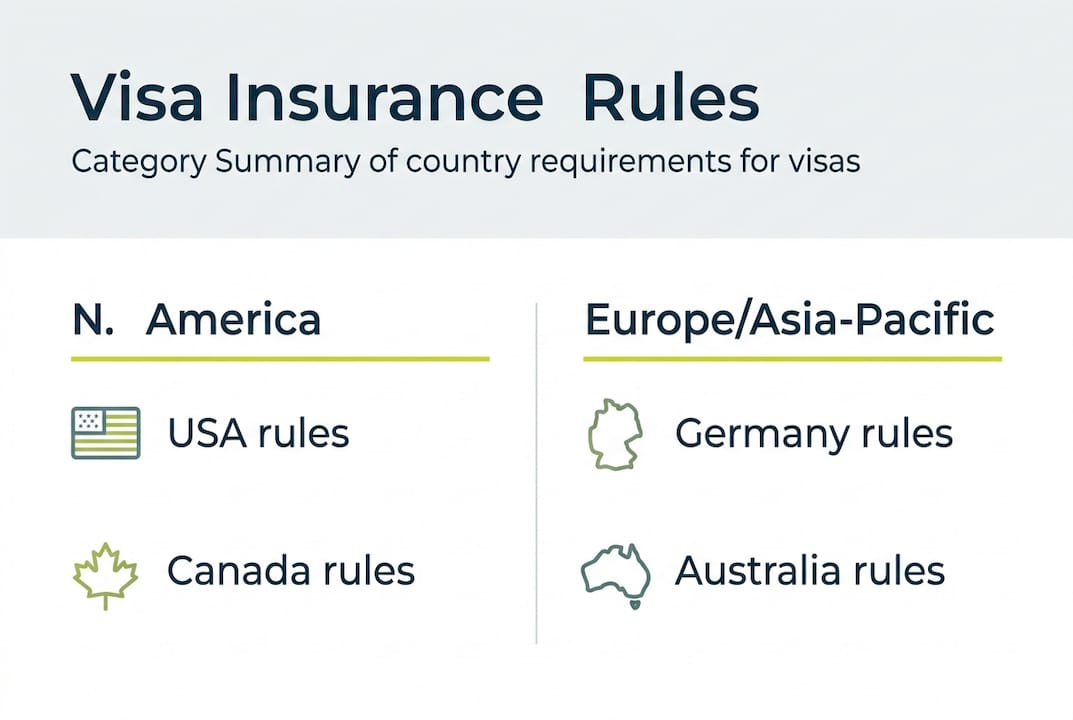
United States: F-1 student visas do not have a single federal mandate, but most universities set their own minimum requirements. J-1 and J-2 exchange visitors must meet federal standards. H-1B and L-1 work visa holders are not federally mandated to hold insurance, but the Affordable Care Act requires minimum essential coverage to avoid tax penalties.
Australia: Australian student visas under Subclass 500 require Overseas Student Health Cover (OSHC) from an approved provider for the entire duration of the stay. Certain nationalities are exempt under bilateral agreements, but most applicants must arrange OSHC before their visa is granted.
Germany: Student and work visa applicants must show proof of health insurance. Those under 30 can access public statutory insurance. Those over 30 or enrolled in certain programmes may need private cover. The distinction matters because consulates check the type of policy, not just its existence.
Canada: The Super Visa for parents and grandparents mandates at least $100,000 in emergency medical cover, valid for a minimum of 365 days, from a Canadian-approved insurer.
| Country | Visa type | Minimum cover | Key requirement |
|---|---|---|---|
| USA | J-1/J-2 | $100,000 per incident | Approved provider, repatriation included |
| Australia | Subclass 500 | Varies by provider | OSHC from approved list only |
| Germany | Student/Work | Statutory or private | Age and status determine type |
| Canada | Super Visa | $100,000 | 365-day validity, Canadian insurer |
To prepare your documentation correctly, follow these steps:
- Confirm the exact insurance standard on the official embassy or consulate website for your nationality.
- Select a policy from an approved or A-rated insurer that matches those standards precisely.
- Obtain a policy certificate showing dates, coverage amounts, and your full name as it appears on your passport.
- Gather proof of payment, as unpaid policies are routinely rejected.
- Check whether a translation is required if your policy is issued in a language other than the host country’s official language.
For a closer look at requirements for US visitor insurance or a broader expat health insurance guide, these resources can help you tailor your preparation.
Pro Tip: Always verify that your chosen insurer appears on the official approved list for your destination. An A-rated insurer that is not on the embassy’s list can still result in rejection.
Choosing the right policy: travel insurance versus expat medical cover
Not all insurance products are built for visa purposes, and choosing the wrong type is a surprisingly common error. The two main categories you will encounter are standard travel insurance and International Private Medical Insurance (IPMI), sometimes called expat medical cover.

Travel insurance is designed for short trips, typically under six months. It covers emergencies, trip cancellation, and sometimes basic medical treatment. For Schengen visas and short-stay tourist visas, a solid travel insurance policy usually meets the requirements. The costs are lower, and the application process is straightforward.
IPMI, by contrast, is built for people who are relocating, studying for a full academic year, or working abroad long-term. It covers routine care, specialist consultations, and ongoing treatment, not just emergencies. IPMI averages around $5,200 per year, reflecting its broader scope. For most long-term and work visas, IPMI is what consulates expect to see.
| Feature | Travel insurance | IPMI/expat cover |
|---|---|---|
| Duration | Up to 6 months | 1 year or more |
| Routine care | Rarely included | Usually included |
| Emergency cover | Yes | Yes |
| Average cost | Lower | Higher (approx. $5,200/year) |
| Suitable for | Tourist, Schengen visas | Work, student, long-stay visas |
Common scenarios where each applies:
- Tourism or short business trip: Standard travel insurance is sufficient.
- Student exchange under 6 months: Travel insurance may qualify, but check university rules.
- Full degree programme abroad: IPMI or a country-specific product like OSHC is required.
- Work relocation: IPMI is almost always necessary, with employer plans sometimes counting.
- Retired expat or senior on a long-stay visa: IPMI with age-appropriate terms is essential.
Explore the range of types of expat insurance available, or compare expat insurance options to find the best fit for your visa category.
Pro Tip: If you hold a multi-entry or long-stay visa, you may need to switch from travel insurance to an IPMI policy after arrival. Plan for this transition before you travel to avoid a coverage gap.
Common pitfalls and expert tips for securing compliant cover
Choosing the right type of policy is only half the challenge. Presenting it correctly and ensuring it meets every technical requirement is where many applicants stumble.
The most frequent documentation failings include:
- Submitting a policy certificate that does not show the exact coverage amount in the required currency.
- Providing proof of a policy that has not yet been paid in full.
- Selecting a deductible or excess that exceeds the embassy’s maximum allowable amount.
- Omitting repatriation of remains, which is a mandatory clause for many Schengen and US visas.
- Failing to include the policy’s start and end dates, which must align precisely with the visa period.
On deductibles, some Schengen consulates permit a deductible of up to €100 to €150, but applying with zero deductible is the safest approach. Pre-existing conditions are routinely excluded from standard policies, which catches many applicants off guard.
For students heading to Germany, it is worth knowing that switching to public insurance post-arrival is permitted in many cases. In Australia, some OSHC benefits carry a 12-month waiting period, so understanding what is covered from day one is critical.
Seniors and minors face additional complexity. Older applicants may find that standard IPMI policies carry age-related exclusions or significantly higher premiums. Minors travelling on a separate visa from their parents need their own compliant policy, not just an add-on.
“Even minor errors can delay or block visa approval. Check requirements line by line, not just at a glance.”
For a thorough review of visitor visa insurance pitfalls, including what to watch for with multi-national and multi-entry applications, it is worth reading before you finalise your paperwork.
Pro Tip: Always submit your insurance documents with a cover note summarising the key figures, coverage dates, and insurer details. This makes it easier for consulate staff to verify compliance quickly and reduces the risk of unnecessary delays.
Why strict insurance rules often save travellers more than they think
There is a tendency to view visa insurance requirements as a bureaucratic hurdle, something to satisfy on paper and then forget. That perspective misses the point entirely.
Healthcare costs in countries like the United States, Australia, and Germany can be staggering. A single emergency hospitalisation in the US can easily exceed $50,000. A medical evacuation from a remote location can cost far more. These are not edge cases; they happen to ordinary travellers and expats every year.
The rules that feel restrictive are, in practice, protecting you. A policy that meets J-1 standards or Canadian Super Visa requirements is not just a visa formality. It is a genuine financial safety net. We have seen applicants opt for the cheapest possible policy to satisfy the minimum requirement, only to discover mid-stay that routine care, dental emergencies, or a pre-existing condition flare-up is entirely excluded.
Robust expat health insurance explained in full detail makes clear that the gap between basic compliance and genuine protection can be significant. Bridge insurance, which covers the period between arrival and enrolment in a local scheme, is another area where many expats are unknowingly uninsured. Waiting period traps, where a policy is technically active but certain benefits do not apply for the first 30 to 90 days, are equally common. Treating your insurance as a meaningful safeguard rather than a checkbox will serve you far better in the long run.
Find trusted insurance for your visa application
Understanding what your visa requires is the essential first step. Acting on that knowledge with the right policy is what protects both your application and your wellbeing abroad.
At Unparalleled Global Benefits, we specialise in helping applicants find visa-compliant insurance across all major destinations and visa categories. Whether you are a student needing OSHC, a professional seeking IPMI, or a senior applying for a Super Visa, we can help you compare plans and find cover that meets embassy standards precisely. Explore the full range of types of expat insurance, review international expat health insurance options, or browse our top insurers to get started quickly and confidently.
Frequently asked questions
What insurance do I need for a Schengen visa?
You need travel medical insurance covering the full Schengen area, with a minimum of €30,000 for emergencies and repatriation. Zero deductible is safest, as some consulates reject policies with any excess, and pre-existing conditions are typically excluded.
Does a US visitor visa require health insurance?
There is no federal insurance mandate for a standard US visitor visa, but uncovered medical costs in the US can be extremely high. Some consulates and sponsors do require proof of cover, so checking your specific situation before applying is strongly advisable.
What is OSHC for an Australian student visa?
OSHC (Overseas Student Health Cover) is a mandatory insurance product for holders of an Australian Subclass 500 student visa, purchased from an approved provider and covering most healthcare costs for the full duration of study.
Can I use travel insurance for long-term expat visas?
Travel insurance is generally only appropriate for short-stay visas of under six months. For long-term, work, or study visas, IPMI averaging $5,200 per year is typically required, as it covers routine care and ongoing treatment that travel policies exclude.
Are pre-existing medical conditions covered in visa insurance?
Most standard visa insurance policies exclude pre-existing conditions unless they have been stable for a defined period, often 12 to 24 months. Always review the policy wording carefully and cross-reference with the specific embassy instructions for your destination.
Recommended
- Medical Insurance for Visit Visa – Protecting Your U.S. Stay – Unparalleled Global Benefits
- Travel Insurance for Visa: Complete Expert Guide – Unparalleled Global Benefits
- Tourist Visa Medical Insurance—Why It Matters – Unparalleled Global Benefits
- Visit Visa Insurance – Essential Cover for Travellers – Unparalleled Global Benefits
- Warum Reiseversicherungen für Disneyreisen unverzichtbar sind – 2000-reisen