

TL;DR:
- International students must carefully verify insurance plans meet specific regional and visa requirements.
- Long-term study benefits from comprehensive health insurance, while short trips may rely on travel coverage.
- Treating insurance as a vital safeguard, not just paperwork, prevents costly emergencies and legal issues.
Insurance is a non-negotiable part of studying abroad, yet most students only discover the fine print after something goes wrong. A missed policy clause, an undisclosed condition, or a plan that fails to meet visa requirements can result in thousands of pounds in unexpected bills or, worse, jeopardise your enrolment entirely. Many universities and countries mandate insurance for international students, with strict minimums that generic travel cover rarely satisfies. This guide cuts through the confusion, explaining exactly what compliance looks like, which plan types suit different study situations, and how to avoid the most common and costly mistakes students make when choosing expat insurance.
Table of Contents
- Understanding expat insurance requirements for international students
- Types of expat insurance: travel vs. comprehensive health for students
- Navigating coverage for pre-existing conditions and exclusions
- Costs, practical tips, and making the best choice for your study destination
- Why picking expat insurance is more than a paperwork exercise
- Find tailored expat insurance for every student journey
- Frequently asked questions
Key Takeaways
| Point | Details |
|---|---|
| Know your visa rules | Insurance requirements vary by country and university—always check the fine print before you buy. |
| Pick the right cover | Short-term travel plans are cheap but limited; comprehensive expat health cover is safer for full academic years. |
| Mind pre-existing conditions | University and public plans are likelier to cover existing health issues than private international medical policies. |
| Budget for real costs | Expect to pay from £50 to £130 per month, with wider coverage and pre-existing options raising premiums. |
| Get expert guidance | Insurance brokers and advisors can ensure you meet compliance and avoid costly gaps in protection. |
Understanding expat insurance requirements for international students
Before you book flights or sign a lease, you need to understand what your university, visa authority, and host country actually require. These are not suggestions. Failing to meet them can result in visa denial, a hold on your academic registration, or being left without cover during a medical emergency.
The requirements vary significantly by region and visa type. Here is what the key frameworks demand:
- US universities (e.g., Penn State): Maximum deductible of $500, pre-existing condition coverage, a $3,000 out-of-pocket maximum, and worldwide coverage. Many institutions will not accept plans that fall short on any single point.
- J-1 visa holders: Minimum $100,000 medical cover per illness or injury, $50,000 for medical evacuation, and $25,000 for repatriation of remains. These are federal requirements, not optional extras.
- Schengen visa (Europe): A minimum of €30,000 in medical cover, valid across all Schengen member states for the full duration of your stay.
- Australia: Overseas Student Health Cover (OSHC) is compulsory for all student visa holders and must be purchased before your visa is granted.
The stakes are rising. Study abroad mandates are up 82% and the student insurance market has surged 180% in 2025, reflecting both growing demand and tightening compliance standards globally. This means insurers and universities are scrutinising policies more carefully than ever before.
Your compliance checklist should include: confirmation of your maximum deductible, minimum medical benefit per illness, evacuation and repatriation cover, mental health inclusion, and whether the policy is valid in your specific host country. You can find a detailed breakdown in our international student health insurance guide to cross-reference your plan against these requirements before you commit.
Never assume that a plan labelled “international” automatically meets your visa or university standards. Always request a certificate of insurance and verify it against the specific requirements listed in your offer letter or visa documentation.
Types of expat insurance: travel vs. comprehensive health for students
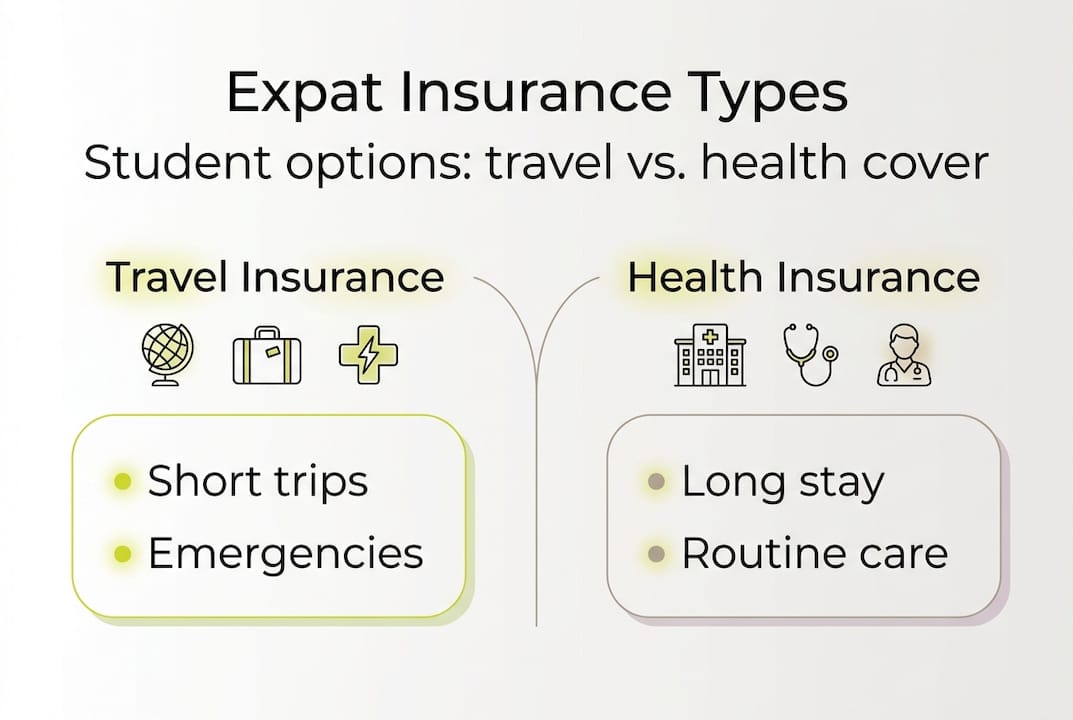
Once you understand the rules, the next step is choosing the right insurance type for your specific circumstances. The two main categories are short-term travel insurance and long-term expat health insurance, also known as International Private Medical Insurance (IPMI). They serve very different purposes.
| Feature | Travel insurance | IPMI / Expat health ||
|—|—|—|
| Best for | Short trips, gap years | Long-term study (6+ months) |
| Emergency cover | Yes | Yes |
| Routine / outpatient care | Rarely | Yes |
| Mental health cover | Limited | Often included |
| Prescription medication | No | Usually included |
| Approximate monthly cost | $61 to $150 | $100 to $350+ |
| Visa compliance | Sometimes | Usually |
Travel insurance suits short trips and gap years, while IPMI is the stronger choice for long-term study, covering outpatient visits, elective procedures, and ongoing care. If you develop a minor illness, need physiotherapy, or require regular prescriptions, a travel policy will likely leave you paying out of pocket.
When should you choose each option?
- University plan: Convenient and often pre-vetted for compliance. Good starting point, but check for mental health and dental exclusions.
- Travel insurance: Suitable for exchange programmes under six months where emergencies are the primary concern.
- IPMI: Ideal for full degree programmes, postgraduate study, or any stay exceeding six months where ongoing health needs are a realistic possibility.
Understanding the differences between travel and health insurance is critical before you sign anything. We also have a dedicated resource on travel vs health insurance explained if you want a side-by-side breakdown.
Pro Tip: If your study programme runs longer than six months or you anticipate needing outpatient care, mental health support, or regular medication, opt for IPMI rather than standard travel cover. Read more about understanding IPMI for students to see why it is worth the additional cost.
Navigating coverage for pre-existing conditions and exclusions
Choosing cover is not only about price. Pre-existing health issues can dictate which plans truly protect you, and this is where many students make their most expensive mistakes.
A pre-existing condition is any illness, injury, or health concern that existed before your policy start date. This includes conditions you may consider minor, such as asthma, anxiety, or a previous sports injury. How insurers treat these conditions varies considerably:
“Pre-existing conditions are often excluded or covered only after waiting periods of 6 to 12 months in private plans. Non-disclosure risks policy cancellation and claim denial.”
University and public health schemes in many countries waive waiting periods entirely, which is one reason they remain popular despite sometimes limited coverage. Private IPMI plans, however, typically apply a 6 to 12 month waiting period or exclude the condition permanently. Non-disclosure risks policy cancellation and leaves you personally liable for any related medical costs.
Here is a step-by-step approach to protecting yourself:
- List every condition you have been diagnosed with or treated for in the past five years, including mental health concerns.
- Ask each insurer directly how they define and handle pre-existing conditions. Request this in writing.
- Check for moratorium underwriting versus full medical underwriting. Moratorium plans automatically exclude conditions for a set period; full underwriting gives you a clearer picture upfront.
- Never omit information to lower your premium. If a claim arises and the insurer discovers non-disclosure, your entire policy can be voided.
- Compare university plans against private options. If your condition is significant, the university plan’s automatic inclusion may outweigh the flexibility of a private IPMI.
For more tailored guidance, our tips for expat student insurance walks you through how to present your medical history to insurers in a way that protects both your cover and your budget.
Costs, practical tips, and making the best choice for your study destination
Knowing your needs and the fine print is half the battle. Now, let us talk money, practical tips, and how to find the right fit for your study destination.

Costs vary considerably depending on where you study, how long you stay, and what level of cover you need.
| Destination / plan type | Approximate cost |
|---|---|
| Study abroad semester (general) | $61 to $150 per month |
| Annual US university plan | $2,000 to $5,500 per year |
| Europe student plan | €110 to €150 per month |
| Australia OSHC | AUD $500 to $650 per year |
Costs vary significantly by plan and destination, so comparing options before committing is essential. A plan that looks affordable at first glance may carry high deductibles that make it expensive when you actually need care.
Here are the most effective ways to reduce your premium without sacrificing compliance:
- Choose a Europe-only policy if your study is confined to Europe. Europe-only plans cost 30 to 50% less than worldwide plans that include the USA and Canada.
- Opt for a higher deductible if you are generally healthy. This can meaningfully reduce your monthly premium.
- Verify waiver compliance before purchasing. Your university may waive their plan if yours meets their criteria, saving you from paying twice.
- Use a specialist broker who works with international students. They can match you to plans that handle pre-existing conditions and meet visa requirements simultaneously.
Pro Tip: Always confirm that your chosen plan meets both your university’s waiver criteria and your visa requirements before paying. These two sets of rules do not always align, and discovering a mismatch after arrival can be both stressful and costly.
We have destination-specific resources to help you plan accurately, including guides for insurance for Indian students abroad and insurance for Canadian students abroad. For a broader overview, our guide on essential protection for international students covers the full decision-making process from start to finish.
Why picking expat insurance is more than a paperwork exercise
We have covered the facts. Here is what most guides miss when it comes to safeguarding your overseas education.
In our experience, students who treat insurance as a box-ticking exercise are the ones most likely to face serious financial or legal consequences. The pattern is consistent: a student chooses the cheapest compliant plan, assumes all is well, and then faces a claim that is denied because of an undisclosed condition, an out-of-network hospital, or a benefit limit they never read.
The students who navigate this well are those who treat their policy as a financial document, not a formality. They read the exclusions. They ask questions before purchasing. They understand that a $200 annual saving on premiums can result in a $15,000 uninsured hospital bill.
Insurance is not just about ticking a box for your visa or your university. It is about protecting the investment you are making in your education and your future. One medical emergency without proper cover can end a study programme entirely. Our expat health insurance guide offers a frank look at what real coverage means for students living abroad long-term.
Find tailored expat insurance for every student journey
Finding the right cover does not have to be overwhelming. At Unparalleled Global Benefits, we specialise in matching international students with compliant, affordable insurance plans across every major study destination.
Whether you need international expat health insurance for a full degree programme or want to understand the types of expat insurance available for your specific situation, our advisors are ready to guide you. You can also browse our top expat insurers to compare plans side by side. Stop guessing and start studying with confidence, knowing your health, your finances, and your visa status are all protected.
Frequently asked questions
What’s the difference between travel insurance and expat health insurance for students?
Travel insurance covers emergencies on short trips, while expat health insurance provides routine and ongoing medical cover for students on longer programmes. If you are studying abroad for more than six months, expat health insurance is almost always the more appropriate choice.
Are pre-existing conditions covered by student expat insurance?
University plans often include pre-existing conditions automatically, but private plans typically exclude them or impose a waiting period of 6 to 12 months before coverage begins. Always declare your full medical history to avoid claim denial.
What documents do I need to show my school or consulate for insurance abroad?
You typically need a certificate of insurance showing your policy period, coverage amounts, and confirmation that the plan meets university or visa requirements. Some institutions also require the insurer’s contact details and a summary of benefits.
How much does student expat insurance cost per month?
Study abroad insurance costs range from approximately $61 to $150 per month for a semester plan, though annual university plans in the US can reach $5,500. Your destination, age, and level of cover all influence the final figure.
Can I get insurance if I’m already abroad and studying?
Some providers do allow students to purchase cover after arrival, but plan access and costs vary considerably compared to purchasing before departure. Options are more limited and premiums tend to be higher, so arranging cover before you travel is strongly advisable.
Recommended
- Selecting The Right “Expat Insurance Provider”
- Types of expatriate insurance: smart cover choices abroad – Unparalleled Global Benefits
- Evaluate StaySure expat insurance: comprehensive cover abroad – Unparalleled Global Benefits
- How to choose expat insurance: global peace of mind – Unparalleled Global Benefits