

TL;DR:
- Most UK travel insurance policies include standard medical evacuation and repatriation coverage with varying limits and conditions. Insurers mainly decide the timing and destination of evacuation, not the traveler, and comprehensive coverage requires understanding specific policy details. GHIC cards do not cover evacuation costs, making specialized insurance essential for adequate protection abroad.
Most comprehensive UK travel insurance policies include medical evacuation and repatriation coverage as standard, but the limits, triggers, and exclusions vary enormously between providers. Medical evacuation (medevac) means transporting you to the nearest facility capable of treating your condition; repatriation means returning you to the UK once you are stable enough to travel, or when home treatment is clinically necessary. Both require insurer pre-authorisation in almost every policy, and neither is covered by your GHIC card or NHS entitlements abroad. The sections below walk you through exactly what is covered, what is not, how decisions are made in a crisis, and what to look for when buying a policy.
- Medical evacuation: transport to the nearest adequate treatment facility
- Repatriation: return to the UK once medically stable or when home care is required
- Both typically require advance approval from the insurer’s assistance team
- For emergency steps, go directly to the step-by-step section below
Table of Contents
- What does medical evacuation and repatriation coverage actually include?
- What is normally not covered — exclusions and common limitations
- How much does evacuation cost, and what are typical policy limits?
- Who actually decides where you go and when you move?
- How to choose the right UK policy for evacuation and repatriation
- If you need help now: step-by-step emergency actions
- What your GHIC card and NHS entitlements do not cover
- Legal and regulatory considerations for medical evacuation and repatriation in the UK
- How COVID-19 and other global health emergencies changed evacuation cover
- Key takeaways
- Why clear policy wording matters more than most travellers realise
- Unparalleledglobalbenefits: finding the right cover for your trip
- Useful sources and further reading
What does medical evacuation and repatriation coverage actually include?
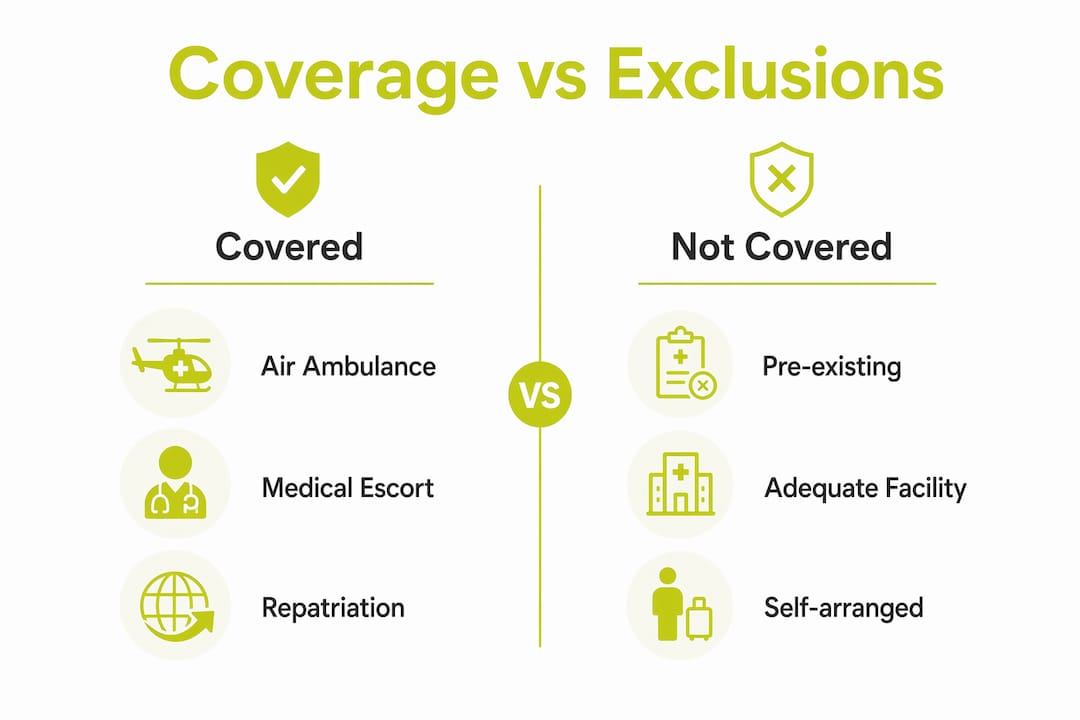
Most policies that include medevac and repatriation cover a broader range of services than travellers expect. Here is what you can typically expect to see in the policy wording:
- Air ambulance: a dedicated medical aircraft with onboard clinical staff, used when commercial transport is not safe or available
- Ground ambulance transfers: transport between hospitals, or from the incident site to an airport
- Stretcher seats on commercial flights: a lower-cost alternative to a full air ambulance when the patient is stable but cannot sit upright
- Medical escort: a nurse or paramedic accompanying you on the flight home
- Repatriation of remains: international transport of a body if the insured person dies abroad, including associated paperwork
- Family travel and accommodation: flights and hotel costs for a relative to travel to your bedside or accompany you home, where the policy specifies this
- Coordination and logistics: the assistance team handles flight bookings, hospital liaison, customs paperwork, and ground transfers
A practical example: a hiker who breaks a femur in a remote area of Nepal may be airlifted by helicopter to Kathmandu, stabilised there, and then repatriated on a stretcher on a commercial flight with a medical escort once doctors confirm she is fit to travel. Each of those legs is a separate cost, and a good policy covers all of them.
Pro Tip: Check specifically whether your policy includes a medical escort as a named benefit. Some policies cover the flight home but not the clinician who must accompany you, leaving a gap that can cost thousands of pounds.

What is normally not covered — exclusions and common limitations
Knowing the exclusions before you travel is as important as knowing what is covered. The most common reasons claims are denied include:
- Pre-existing conditions: unless declared at the time of purchase and accepted by the insurer (sometimes with an additional premium), conditions you already have are typically excluded
- Elective or non-emergency treatment: travelling abroad specifically to receive medical care, then claiming repatriation, is not covered
- High-risk activities and competitive sport: many standard policies exclude professional sport, motor racing, mountaineering above a set altitude, and similar activities unless you purchase an adventure sports extension
- War, civil unrest, and terrorism: most policies exclude evacuation from active conflict zones; specialist war-risk cover exists separately
- Travel against government advice: if the Foreign, Commonwealth & Development Office (FCDO) advises against all travel to a destination and you go anyway, your policy is likely void
- Psychiatric-only evacuations: some policies exclude evacuation where the sole reason is a mental health crisis, though this is changing in newer policy wordings
- Unauthorised evacuations: if you arrange your own transport without contacting the insurer first, the claim is frequently denied
Watch for these red flags in policy wording. “Adequate facility” language is particularly important: insurers interpret “adequate” clinically, not by your personal preference, and that interpretation controls whether an evacuation is authorised at all. A hospital that meets clinical standards for your condition may be deemed adequate even if you would prefer to be treated at home. Sub-limits also matter: a policy with £10 million in overall medical cover may cap evacuation at £25,000, which falls well short of real-world costs, given that industry sources consistently cite medical evacuation costs from $25,000 to over $250,000 depending on distance and circumstances.
Pro Tip: Ask the insurer directly: “What is your definition of an adequate medical facility?” If the answer is vague, that is a warning sign. A clear, written definition protects you.
How much does evacuation cost, and what are typical policy limits?
Air ambulance costs are one of the most frequently underestimated risks in travel insurance. Medevac costs typically range from $25,000 to over $250,000 depending on distance, mode of transport, and the level of medical care required en route. Repatriation of remains carries its own significant price tag: international body repatriation commonly costs $10,000–$50,000, while shipping cremated remains is often around $300.
Cost callout: A long-haul air ambulance from Southeast Asia or the Americas to the UK can exceed $200,000. A policy with a £25,000 evacuation cap leaves you exposed to six-figure costs.
| Cost item | Typical range | Notes |
|---|---|---|
| Air ambulance (short-haul, e.g. Europe) | $25,000–$250,000 | Varies by aircraft type and medical crew |
| Air ambulance (long-haul, e.g. Asia/Americas) | $100,000–$250,000+ | Intercontinental flights with full medical team |
| Commercial stretcher repatriation | $10,000–$50,000 | Requires blocking multiple seats and medical escort |
| Repatriation of remains | $10,000–$50,000 | Includes embalming, casket, customs paperwork |
| Shipping of cremated remains | ~$300 | Significantly lower cost option |
Industry guidance recommends substantial evacuation cover for most travellers, with higher limits for remote destinations or hazardous activities. Some specialist policies offer much higher limits.
Who pays up front matters too. In most cases, the insurer’s assistance team arranges and pays the provider directly, which avoids you needing to find tens of thousands of pounds in an emergency. Some policies, however, require you to pay and then claim reimbursement. Confirm this before you travel.
- Check whether your policy pays providers directly or reimburses you after the fact
- Verify that the evacuation limit is separate from, and not shared with, the general medical expenses limit
- Credit card evacuation benefits often carry tighter conditions than standalone travel policies; do not assume your card covers you adequately
Who actually decides where you go and when you move?
This is where many travellers are surprised. Emergency assistance professionals consistently note that travellers commonly overestimate their control over evacuation decisions. The insurer’s medical team and the treating clinician usually determine timing and destination, not the patient.
The process typically works like this:
- The treating local physician assesses whether the patient can be safely moved and what level of care is needed in transit
- The insurer’s 24/7 assistance team reviews the medical report and determines whether local facilities are adequate
- If evacuation is approved, the assistance team arranges the transport provider, medical escort, and receiving hospital
- The patient is moved to the nearest appropriate facility, which may not be the UK
Common myths:
- “I can demand to be flown home.” Not automatically. Repatriation to the UK is approved when it is medically appropriate, not simply on request.
- “I can choose which hospital I go to.” The insurer and treating physician choose the nearest clinically adequate facility.
- “If I arrange my own evacuation, I can claim it back.” Unauthorised evacuations are frequently denied by insurers.
Pro Tip: Save your insurer’s 24/7 assistance number in your phone before you travel. In a crisis, finding that number wastes critical time.

How to choose the right UK policy for evacuation and repatriation
Not all travel policies are equal on this point. Use this checklist when comparing options:
What to check in the policy wording:
- Evacuation and repatriation limits (industry guidance recommends at least £100,000 for most travellers, with higher limits for remote or adventure travel)
- Whether limits are shared with general medical expenses or ring-fenced
- 24/7 assistance helpline with a documented, direct number
- Medical escort included as a named benefit
- Repatriation of remains covered, with a stated limit
- Geographic scope: does the policy cover every country on your itinerary?
- Pre-existing conditions: are yours declared, accepted, and covered?
- Adventure sports or hazardous activities extension if relevant
- Exclusions for FCDO travel advisories
Questions to ask your insurer or broker:
- What is your definition of an “adequate” medical facility?
- Does the policy pay providers directly, or do I pay and claim back?
- What is your typical response time from first call to evacuation dispatch?
- Can you give an example of a recent evacuation you arranged from my destination region?
- Is there a sub-limit on evacuation that is separate from the overall medical limit?
- How do I notify you of a pre-existing condition, and what documentation do you need?
Some premium credit cards and specialist memberships include evacuation benefits, but their conditions are often tighter than a dedicated travel policy. Always verify the specific limits and exclusions rather than assuming full protection. For travellers with pre-existing conditions, a specialist policy that explicitly covers those conditions is worth the additional premium. See Unparalleledglobalbenefits’s guide to travel insurance for health conditions for more detail on this.
If you need help now: step-by-step emergency actions
If you or someone you are travelling with needs emergency medical assistance abroad, follow these steps in order:
- Call emergency services at your location immediately if there is an immediate threat to life.
- Contact your insurer’s 24/7 assistance line as soon as it is safe to do so. Give your policy number, your location, and a brief description of the medical situation.
- Follow the local clinician’s advice on immediate treatment. Do not refuse local care while waiting for evacuation approval.
- Do not arrange your own transport unless you face an immediate, life-threatening situation with no other option. Unauthorised evacuations are frequently not covered.
- Document everything: collect hospital admission notes, itemised invoices, prescriptions, and the names of treating doctors.
- Keep all receipts for any out-of-pocket expenses, including accommodation for family members.
- Photograph injuries, hospital surroundings, and any relevant circumstances where it is safe and appropriate to do so.
- Notify your insurer of any change in your condition that might affect transport decisions.
- Submit your claim within the insurer’s deadline. Insurers commonly set submission windows of 30–90 days and require itemised invoices and supporting medical paperwork. Missing the deadline risks denial.
- Arrange certified translations of any foreign-language medical documents before submitting your claim.
Documentation to collect at the scene:
- Hospital admission and discharge notes
- Itemised invoices for all treatment
- Prescriptions and medication records
- Passport and policy documents
- Contact details of witnesses if relevant
Pro Tip: Never self-arrange an evacuation and expect reimbursement unless you are in immediate, life-threatening danger with no way to reach your insurer. Even then, call as soon as you possibly can and document every decision you made and why.
What your GHIC card and NHS entitlements do not cover
This is one of the most persistent misconceptions among UK travellers. GHIC and EHIC provide access to some necessary healthcare in EU and EEA countries at local rates, but they explicitly do not cover medical evacuation or repatriation costs. The NHS does not extend its funding to international medical transport under any circumstances.
What GHIC does and does not do:
- Does: give you access to state-provided healthcare in EU/EEA countries at the same cost as a local resident (which may still involve charges)
- Does not: pay for an air ambulance, stretcher transfer, medical escort, or repatriation flight
- Does not: cover treatment in private hospitals, even in EU countries
- Does not: apply outside the EU/EEA (no cover in the USA, Canada, Australia, Asia, etc.)
When you are repatriated to the UK, the insurer’s assistance team will coordinate with the receiving NHS hospital or private facility depending on your circumstances and preference. NHS hospitals accept repatriated patients through normal admission channels; the insurer handles the logistics of the transfer, not the ongoing NHS treatment costs once you are home.
Pro Tip: Apply for your free GHIC card before any EU trip, but treat it as a supplement to travel insurance, never a replacement. The GOV.UK foreign travel insurance guidance makes this explicit.
| Cover type | Medical evacuation | Repatriation | Overseas treatment |
|---|---|---|---|
| GHIC/EHIC | No | No | Partial (EU/EEA state hospitals only) |
| NHS entitlements | No | No | No (outside UK) |
| Travel insurance (comprehensive) | Yes (subject to limits) | Yes (subject to limits) | Yes (subject to limits) |
Legal and regulatory considerations for medical evacuation and repatriation in the UK
In the UK, travel insurance is regulated by the Financial Conduct Authority (FCA). Any insurer selling policies to UK residents must be FCA-authorised, which means their policy terms must be clear, fair, and not misleading under the Consumer Duty rules that came into force in 2023. This matters for evacuation cover because it means insurers cannot bury critical exclusions in small print without drawing your attention to them.
The FCDO’s travel advisories carry legal weight in most UK travel policies. Travelling to a destination rated “advise against all travel” typically voids your policy entirely, including evacuation cover. Check the FCDO website before every trip and again shortly before departure, as advisories can change rapidly.
For students studying abroad, the same FCA-regulated framework applies, though many student-specific policies are arranged through universities or specialist brokers. What is student repatriation coverage in this context? It is the same benefit as in a standard travel policy, but the policy may be structured as an annual multi-trip or a long-stay single-trip policy rather than a short-term holiday product. Students should confirm that their policy covers the full duration of their course and that pre-existing conditions are declared.
Repatriation of remains involves additional legal requirements: death certificates must be authenticated, embalming may be required by the destination country’s regulations, and customs documentation must be completed correctly. The insurer’s assistance team handles this, but families should be aware that the process can take days to weeks depending on the country involved.
How COVID-19 and other global health emergencies changed evacuation cover
The COVID-19 pandemic exposed significant gaps in standard travel policies. Early in the pandemic, many insurers excluded COVID-19-related claims entirely, leaving travellers stranded without evacuation cover when borders closed and commercial flights were suspended. The industry has since adapted, but the lessons are worth understanding.
Most UK travel policies now include COVID-19 as a covered medical condition for emergency treatment and repatriation, provided the traveller has not travelled against FCDO advice. However, some policies still exclude pandemic-related border closures or government-mandated quarantine costs from their cancellation and curtailment sections, so read the wording carefully.
Broader global health emergencies create a different challenge: when a country declares a public health emergency, commercial flights may be suspended, borders may close, and the insurer’s normal evacuation routes may become unavailable. Specialist international evacuation policies and membership organisations maintain dedicated aircraft and ground networks for these scenarios. This is one reason why standard travel insurance and specialist medevac memberships are sometimes held alongside each other by frequent travellers and expatriates.
For expatriates on long-term assignments, an international health insurance policy rather than a short-term travel policy is usually more appropriate, as it provides continuous cover and typically includes more robust evacuation provisions for extended stays.
Key takeaways
Medical evacuation and repatriation coverage is a standard component of most comprehensive UK travel policies, but limits, exclusions, and decision-making authority vary significantly, making it essential to read the policy wording carefully before you travel.
| Point | Details |
|---|---|
| Recommended minimum cover | Aim for substantial evacuation cover; consider higher limits for remote or adventure travel. |
| Contact insurer first | Always call the 24/7 assistance line before arranging any transport; unauthorised evacuations are frequently not covered. |
| GHIC does not replace insurance | GHIC/EHIC covers some EU/EEA treatment but never pays for evacuation or repatriation costs. |
| Declare pre-existing conditions | Undeclared conditions are a leading cause of claim denial; declare everything at the point of purchase. |
| Unparalleledglobalbenefits support | Unparalleledglobalbenefits helps travellers, expats, and students find policies with adequate medevac and repatriation limits matched to their destination and health profile. |
Why clear policy wording matters more than most travellers realise
Most people buy travel insurance and file it away, assuming the cover is there when they need it. The reality is that evacuation and repatriation claims are among the most complex in travel insurance, precisely because they involve multiple parties, significant costs, and decisions made under pressure. The gap between what a traveller assumes is covered and what the policy actually says is where most disputes arise.
What concerns me most, having worked with international travellers and expatriates across a wide range of destinations, is the “adequate facility” problem. Insurers define adequacy clinically, and that definition can mean you are kept in a local hospital that meets the clinical threshold for your condition, even if you would strongly prefer to be home. Understanding this before you travel, not during a crisis, is what allows you to choose a policy with wording that better protects your interests.
The other underappreciated issue is the pre-authorisation requirement. Travellers in distress sometimes arrange their own transport, believing they can claim it back. They usually cannot. The insurer’s right to control the logistics is not just a cost-saving measure; it is the mechanism by which they manage the entire claim. Working with a knowledgeable broker who can explain these mechanics, and who can match your policy to your actual risk profile, makes a genuine difference to the outcome when something goes wrong.
Unparalleledglobalbenefits: finding the right cover for your trip
When the cost of a long-haul air ambulance can exceed $200,000, the difference between a policy with a £25,000 evacuation cap and one with at least £100,000—or even higher for specialist policies—of cover is not a detail. Unparalleledglobalbenefits works with travellers, expatriates, and students to identify policies that carry adequate medevac and repatriation limits for their specific destination, activity level, and health profile, rather than defaulting to the cheapest option that leaves critical gaps.
Whether you need a single-trip policy for a gap year, long-term cover as an expat, or a specialist plan that covers pre-existing conditions, Unparalleledglobalbenefits can help you compare options and understand the wording before you commit. Get a personalised quote by visiting the expat insurance provider guide or contact the team directly for advice on your situation.
Planning a trip for yourself, a resident, or visiting family? UGB + Ekta can arrange travel insurance for seniors up to 100 years old. Just click here: https://ektatraveling.com/?partner_uid=808 and add the promo code “UGB” to receive an additional 10% discount.
Watch this short overview to understand how international medical cover works in practice:
Useful sources and further reading
The following sources were used in preparing this guide and are worth consulting directly for policy comparisons, official guidance, and cost data:
- GOV.UK — Foreign travel insurance: the UK government’s official guidance on why travel insurance is necessary and what to look for; authoritative on FCDO advisory interactions with policy validity
- NHS.UK — Apply for a GHIC: official application page and explanation of what GHIC covers and does not cover abroad
- MoneySuperMarket — Repatriation travel insurance: clear consumer-facing explanation of what repatriation cover includes in standard UK policies
- LegalClarity — Repatriation insurance explained: detailed breakdown of costs, claims process, and common exclusions including repatriation of remains cost ranges
- Squaremouth — Medical evacuation insurance: cost data and definitions for medevac and repatriation benefits, including the $25,000–$250,000+ cost range
- NerdWallet — Medical evacuation insurance: practical guidance on recommended minimum cover limits and how to evaluate policy adequacy
- Global Rescue — Repatriation benefits explained: industry-level insight into how assistance teams coordinate logistics and the decision-making process during evacuations
This article is general information, not professional insurance or legal advice. Policy terms, limits, and exclusions vary between providers. Always read your policy wording in full and confirm current FCDO advisories with the relevant primary sources before travelling.
Recommended
- Medical evacuation and repatriation insurance explained – Unparalleled Global Benefits
- Medical evacuation insurance: protecting your health abroad – Unparalleled Global Benefits
- Medical Evacuation Coverage: Vital Protection Abroad – Unparalleled Global Benefits
- Complete Guide to Medical Evacuation Insurance Cover – Unparalleled Global Benefits