

Yes, visitors can get coverage for pre-existing medical conditions. The key is understanding how the system works before you book. Most visitor insurance policies exclude pre-existing conditions by default, but two pathways exist: a pre-existing condition exclusion waiver and acute onset coverage. Both require action on your part, and timing matters more than most travellers realise.
Here is what visitors coverage for pre-existing conditions typically includes:
- Emergency medical treatment for stable pre-existing conditions, subject to waiver eligibility
- Medical evacuation to the nearest appropriate facility or back home
- Trip cancellation and interruption reimbursement when a pre-existing condition forces a change of plans
- A look-back period of 60 to 180 days before policy purchase, during which any diagnosis, treatment, or medication change defines a condition as “pre-existing”
- A stability requirement: your condition must be medically stable at the time you buy the policy
- A purchase window: waivers typically require you to buy within 14 to 21 days of your initial trip deposit
- A mandatory declaration obligation: you must disclose all relevant conditions honestly at purchase to avoid claim denial, as insurers use look-back periods to verify eligibility.
Coverage does not extend to conditions that are actively deteriorating, undergoing elective treatment, or that you knew about but failed to declare.
What counts as a pre-existing condition for visitor insurance?
The industry definition is more precise than most people expect. A pre-existing condition is any illness, injury, or medical concern for which you received a diagnosis, treatment, medication, or showed symptoms within a specified period before your policy start date. That period is the look-back window, and it ranges from 60 to 180 days depending on the plan you choose.

Crucially, a condition does not need a formal diagnosis to qualify. If you visited a doctor about chest tightness two months before departure and your policy has a 90-day look-back, that visit places the condition within scope, even if no diagnosis was recorded.
Common conditions that fall under this definition include:
- Diabetes (Type 1 and Type 2)
- Heart disease and hypertension
- Asthma and COPD
- Arthritis
- Cancer in remission
- High blood pressure managed by medication
The distinction between stable and unstable conditions is where eligibility hinges. A stable condition is one where your medication, treatment plan, and symptoms have not changed materially during the look-back period. An unstable condition, such as one requiring a recent dosage adjustment or a new prescription, typically disqualifies you from waiver eligibility.
Your nationality or residency can also affect your options. Some plans are designed specifically for visitors to particular countries, and age caps vary. Certain plans cover travellers up to age 99, while others cap pre-existing condition coverage at 70 or 79. Checking these limits before purchase is not optional.
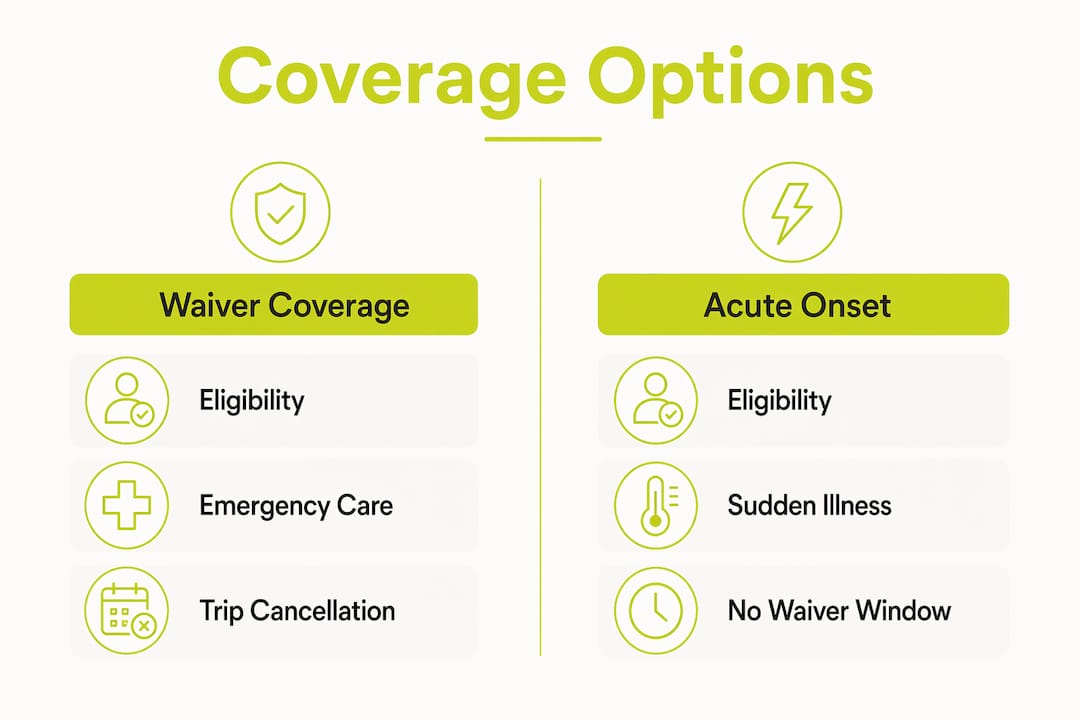
What coverage options are available for pre-existing conditions?
Two distinct routes exist, and they are not interchangeable.

Pre-existing condition exclusion waiver
A waiver removes the exclusion entirely, treating your chronic condition like any other covered medical event. To qualify, you generally must:
- Purchase the policy within 14 to 21 days of your initial trip deposit
- Be medically stable and fit to travel at the time of purchase
- Insure 100% of your prepaid, non-refundable trip costs
- Choose a plan that explicitly offers a waiver option
Once a waiver applies, coverage typically extends to emergency medical treatment, medical evacuation, trip cancellation, and trip interruption caused by a flare-up of the covered condition. Some policies also extend this protection to non-travelling family members whose medical issues force a trip cancellation, though this varies by plan.
Acute onset coverage
This is the alternative for travellers who miss the waiver window or whose plans do not offer one. Acute onset coverage pays for sudden, unexpected, and severe flare-ups of a pre-existing condition that require emergency treatment. It is built into many visitor insurance plans without a purchase deadline and is available year-round. The critical limitation: it covers emergencies only, not routine management, follow-up appointments, or conditions that were visibly worsening before departure.
Pro Tip: Buy your policy as soon as you make your first trip payment. Missing the 14-to-21-day window closes the waiver route permanently for that trip, leaving you with acute onset coverage as your only fallback.
When selecting between the two, consider your health situation honestly. If your condition is stable and you are booking early, a waiver gives you the broadest protection. If you are booking last-minute or your condition has been active recently, acute onset coverage is still meaningful protection for genuine emergencies.
For a broader look at how travel insurance handles medical conditions, Unparalleledglobalbenefits has detailed guidance on eligibility and what to expect from the claims process.
What exclusions and pitfalls should you watch out for?
Exclusions in visitor insurance for pre-existing conditions are specific, and misunderstanding them is the most common reason claims get denied.
Standard exclusions include:
- Conditions that worsened or required new treatment within the look-back period
- Elective procedures, whether planned before or during the trip
- Terminal illnesses known at the time of purchase
- Conditions related to a disability present at the time of purchase
- Any illness or injury you failed to declare honestly
Declaration is not optional. Insurers apply look-back periods precisely to verify whether a claim relates to a condition you had before purchasing. Non-disclosure can result in full claim exclusion, leaving you personally liable for medical bills that can reach tens of thousands of pounds abroad.
Common pitfalls that catch travellers off guard:
- Missing the purchase window: waiting more than 21 days after your initial deposit eliminates waiver eligibility
- Underinsuring trip costs: you must cover 100% of prepaid, non-refundable costs to qualify for a waiver; partial coverage disqualifies you
- Misreading acute onset scope: acute onset does not cover chronic management, only genuine emergencies
- Assuming annual policies cover pre-existing conditions: annual travel insurance plans do not cover pre-existing conditions; this protection is only available on a per-trip basis
Pro Tip: Read the certificate of insurance before you buy, not after. The pre-existing condition clause, look-back period, and stability definition are all in there. If anything is unclear, contact the insurer directly before purchasing.
The GOV.UK foreign travel insurance guidance also recommends declaring all medical conditions to your insurer and checking that your policy covers the specific activities and health needs of your trip.
How much does visitors coverage for pre-existing conditions cost?
Cost depends on four main variables: your age, the severity and stability of your condition, your trip duration, and your destination. For acute onset coverage, having a pre-existing condition typically does not increase your premium because the benefit is built into the standard plan price. A 65-year-old traveller might pay $80–$150 for a 30-day comprehensive plan that includes acute onset coverage.
A full pre-existing condition waiver may carry a small surcharge, but financial experts note that the waiver often adds little or no extra cost if eligibility criteria are met. The real financial risk lies in travelling without adequate coverage. A single hospitalisation abroad can cost tens of thousands of pounds out of pocket.
Key cost and timing considerations:
- Buy within 14–21 days of your first deposit to access waiver pricing and eligibility
- Insure the full trip cost: partial coverage disqualifies you from waiver benefits and leaves gaps in trip cancellation protection
- Per-trip purchase only: pre-existing condition coverage cannot be added to an annual multi-trip policy; each trip requires a separate policy
- Age affects limits: coverage maximums and age caps vary, so compare plans carefully if you are over 70
Shopping early is not just about saving money. It is the only way to keep all your options open.
How Unparalleledglobalbenefits supports visitors with pre-existing conditions
Unparalleledglobalbenefits specialises in international visitor insurance for people who need more than a standard off-the-shelf policy. The team works with travellers who have stable pre-existing conditions, helping them identify plans that include waivers, acute onset protection, and tailored benefits suited to their health profile and trip length.
Plans arranged through Unparalleledglobalbenefits for visitors with pre-existing conditions typically include:
- Emergency medical treatment for covered conditions, subject to stability and declaration requirements
- Medical evacuation to the nearest appropriate facility
- Trip cancellation and interruption cover linked to pre-existing condition flare-ups
- Access to plans covering travellers up to age 99 for certain conditions
- Guidance on UK regulatory alignment and compliance with official travel insurance recommendations from GOV.UK
For visitors to the UK specifically, residency and nationality affect which plans are available and what limits apply. Unparalleledglobalbenefits navigates these distinctions as part of the advice process, rather than leaving you to decode policy small print alone.
“Having a pre-existing condition does not bar travellers from obtaining coverage. The critical factor is understanding and securing the waiver clause, which removes exclusions often with minor surcharges or no added cost if eligibility criteria are met.” — MoneySavingExpert
For travellers comparing their options, the 2026 guide to comparing travel insurance with medical conditions from Unparalleledglobalbenefits walks through the key criteria to evaluate before committing to a policy.
How do you make a claim for a pre-existing condition?
The claims process for pre-existing condition coverage follows a clear sequence, but preparation before your trip makes the difference between a smooth reimbursement and a prolonged dispute.
Before departure:
Gather documentation of your condition’s stability. This includes recent medical records, a letter from your GP confirming your current treatment plan, and a list of all medications with dosages. Keep copies of your insurance certificate, policy number, and the insurer’s 24-hour emergency contact number.
During a medical event abroad:
Contact your insurer’s emergency assistance line as soon as possible, ideally before receiving non-emergency treatment. For inpatient hospitalisation, most plans require pre-certification within 48 hours of admission. Failure to pre-certify can result in a reduction of eligible medical expenses or denial of the claim.
When submitting a claim:
- Completed claim form from your insurer
- All original medical bills and receipts
- Medical reports from the treating facility, including diagnosis and treatment details
- Proof of your pre-existing condition’s stability (GP records, prescription history)
- Proof of trip costs and any non-refundable expenses if claiming trip cancellation
- Your insurance certificate and policy documents
Insurers will review your medical history against the look-back period to confirm the claim relates to a covered condition. Gaps in documentation are the most common reason for delayed or partial settlements.
How do you compare visitor insurance policies for pre-existing conditions?
Not all visitor insurance plans treat pre-existing conditions the same way, and the differences matter considerably. When comparing options, focus on these criteria rather than headline premium prices.
Look-back period length: a 60-day look-back is more favourable than a 180-day one if your condition has been recently active. Shorter look-back periods reduce the window during which a condition can be flagged.
Coverage type: waiver coverage is broader than acute onset coverage. If you qualify for a waiver, prioritise plans that offer it. If you do not, confirm that acute onset coverage is explicitly included and check its limits.
Medical coverage limits: as a benchmark, look for at least $50,000 in emergency medical coverage and $100,000 in medical evacuation coverage. Seniors, travellers with cardiac conditions, and those visiting destinations with high medical costs may need higher limits.
Age caps: some plans cap pre-existing condition coverage at age 70 or 79. If you are older, verify the plan’s maximum age for this specific benefit.
Purchase window: confirm how many days after your initial deposit you have to buy. Plans with longer purchase windows give you more flexibility.
Trip cost insured: the plan must cover 100% of your prepaid, non-refundable costs to qualify for waiver benefits. Partial coverage disqualifies you.
Per-trip basis: pre-existing condition coverage is only available on individual trip policies, not annual plans. Factor this into your budget if you travel frequently.
For travellers with health conditions who want practical guidance on what to look for, the best insurance for health conditions resource from Unparalleledglobalbenefits covers these evaluation criteria in detail.
Which conditions are commonly covered or excluded by UK visitor insurance?
Conditions that commonly qualify for coverage:
Travellers with diabetes, heart disease, asthma, or cancer in remission generally qualify for pre-existing condition coverage when their condition is stable and they purchase insurance within the required window. Arthritis, hypertension managed by medication, and COPD also appear frequently on covered condition lists under both waiver and acute onset plans.
Cancer in remission is worth highlighting specifically. Many plans provide acute onset coverage for sudden emergencies related to remission-stage cancer. Active cancer treatment is a different matter, and options are considerably more limited in that scenario.
Conditions that are typically excluded:
- Terminal illnesses known at the time of purchase
- Conditions that were actively deteriorating or required new treatment within the look-back period
- Elective procedures, including planned surgery or cosmetic treatments
- Mental health conditions, though some plans are beginning to include limited cover
- Disabilities present at the time of purchase, in many standard plans
The boundary between covered and excluded often comes down to stability. A diabetic traveller whose insulin dose has not changed in six months is in a very different position from one whose endocrinologist adjusted their prescription three weeks before departure. The former is likely eligible; the latter may not be.
Pro Tip: If you are unsure whether your condition qualifies, contact your insurer before purchasing and ask them to confirm in writing. A verbal assurance is not binding; written confirmation protects you if a claim arises.
Key takeaways
Visitors coverage for pre-existing conditions is accessible to most travellers with stable health conditions, provided they purchase within the 14-to-21-day waiver window and declare all relevant medical history honestly.
| Point | Details |
|---|---|
| Buy within the waiver window | Purchase within 14–21 days of your first trip deposit to access full pre-existing condition waiver coverage. |
| Stability is the eligibility test | Your condition must show no recent changes in treatment, medication, or symptoms during the look-back period of 60–180 days. |
| Acute onset as a fallback | If you miss the waiver window, acute onset coverage still protects you for sudden, unexpected emergencies abroad. |
| Declare everything honestly | Non-disclosure of a pre-existing condition can result in full claim exclusion, leaving you liable for all costs. |
| Per-trip purchase only | Pre-existing condition coverage is not available on annual policies; each trip requires a separate plan. |
Planning a trip for yourself, a resident, or visiting family? Unparalleledglobalbenefits and Ekta can arrange travel insurance for seniors up to 100 years old. Add the promo code UGB at checkout to receive an additional 10% discount.
For a full overview of international health insurance options, including plans suited to visitors with complex medical histories, visit the international health insurance guide from Unparalleledglobalbenefits.
Watch our short guide on securing the right cover before you travel:
Recommended
- Go compare travel insurance with medical conditions: 2026 guide – Unparalleled Global Benefits
- Compare travel insurance with medical conditions: 2026 guide – Unparalleled Global Benefits
- Health Insurance Visitor Visa – Key Protection For Travellers – Unparalleled Global Benefits
- Compliance for expat health insurance: 2026 guide – Unparalleled Global Benefits