

TL;DR:
- Travel vaccination centers evaluate your trip plans and administer vaccines following WHO guidelines. Booking 6 to 8 weeks ahead ensures full protection, especially for multi-dose vaccines. Only accredited clinics can issue valid Yellow Fever certificates for international entry.
An international travel vaccination centre is a specialised healthcare provider that assesses your travel plans and delivers the vaccines you need to stay healthy abroad. These clinics operate under guidelines from bodies such as the World Health Organisation (WHO) and the National Travel Health Network and Centre (NaTHNaC), making them the authoritative source for vaccination for travel. Health experts recommend booking your appointment at least 6–8 weeks before departure to allow full vaccine effectiveness. That lead time matters because several vaccines require multiple doses spaced weeks apart, and rushing the schedule leaves you only partially protected.
What does an international travel vaccination centre do?
A travel health clinic does far more than administer injections. It provides a full risk assessment based on your destination, your itinerary, your medical history, and your planned activities. The consultation covers vaccines, malaria prophylaxis, food and water safety, and insect bite precautions. Think of it as a personalised health briefing for your specific trip, not a generic checklist.

The standard industry term for these services is “travel medicine,” and the clinics that deliver them range from NHS travel health services to private travel health clinics. Both types follow NaTHNaC and WHO protocols, though private clinics often offer faster appointments and a wider stock of vaccines on site.
What should you bring to your travel health clinic appointment?
Preparation before your appointment determines how useful the consultation will be. The more detail you provide, the more tailored your travel health plan becomes.
Bring the following to your appointment:
- Full travel itinerary. Include every country you will visit, transit through, and the duration of each stay. Transit country details are critical because some countries require proof of vaccination even for a brief stopover.
- Planned activities. Safari, trekking, rural village stays, and freshwater swimming each carry different health risks. Your clinician needs this context.
- Immunisation records. Bring your NHS vaccination record or any previous vaccine certificates. This prevents duplicate doses and confirms which routine vaccines need updating.
- Medical history and current medications. Some vaccines are contraindicated with certain conditions or drugs. Full disclosure protects you.
- Passport details. Required for issuing official travel vaccination certificates.
Pro Tip: If you are travelling through multiple countries, list every airport where you have a layover, even if it is only two hours. Some Yellow Fever endemic countries require a valid certificate for transit passengers, and missing this detail can result in being denied boarding.
How to choose the right international travel vaccination centre
Not every clinic can provide every service. The most important distinction is accreditation, particularly for Yellow Fever vaccination.
Yellow Fever accreditation
Only government-approved centres can administer the Yellow Fever vaccine and issue the International Certificate of Vaccination or Prophylaxis (ICVP), commonly known as the “Yellow Card.” This is a legal requirement, not a preference. If you receive the Yellow Fever vaccine at a non-accredited clinic, the certificate will not be valid for entry into countries that require it. Confirm accreditation before you book.
NHS versus private travel health clinics
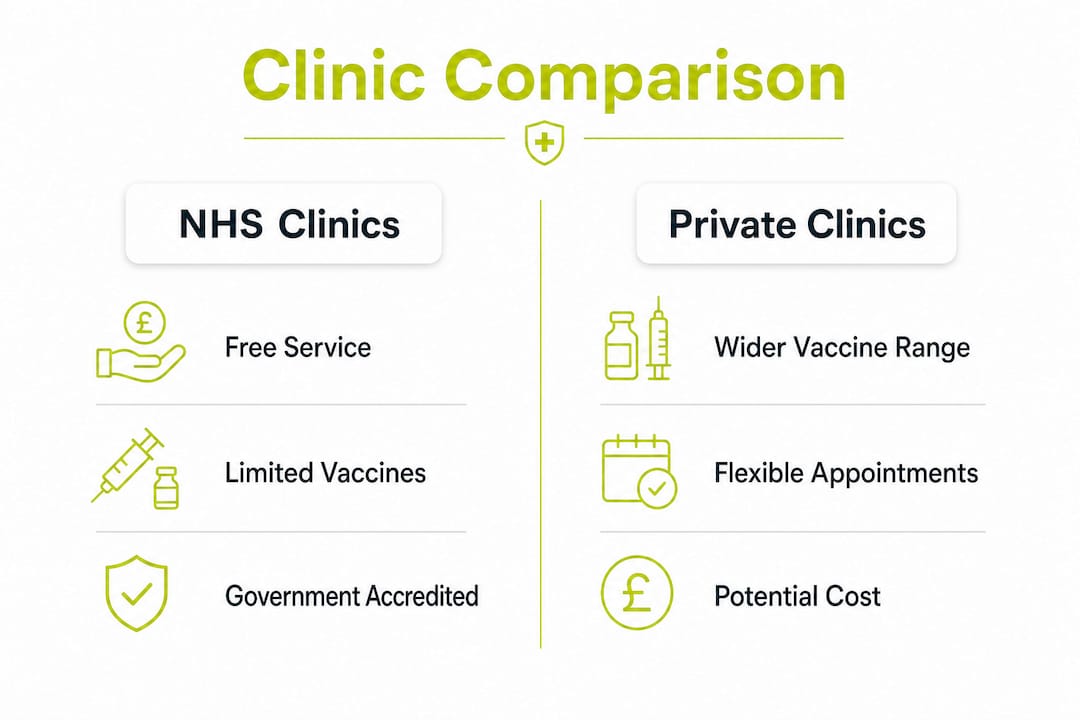
NHS GP surgeries offer some travel vaccinations free of charge, including typhoid, hepatitis A, and cholera for eligible travellers. However, not all GP practices provide a full travel medicine service, and waiting times can be longer. Private travel health clinics typically stock a broader range of vaccines, offer same-day appointments, and can issue prescriptions for malaria prophylaxis during the same visit.
Practical checklist for choosing a clinic
- Confirm the clinic is a designated Yellow Fever Vaccination Centre if your destination requires it.
- Check whether the clinic stocks the specific vaccines your itinerary demands.
- Ask whether malaria prophylaxis prescriptions are available on site.
- Verify whether walk-in or urgent appointments are offered for last-minute travellers.
- Request a clear breakdown of travel vaccine costs before attending, as prices vary considerably between providers.
Pro Tip: Search the NaTHNaC “TravelHealthPro” website or the NHS Fit for Travel portal to find accredited Yellow Fever centres near you. Both are free, government-backed resources updated regularly.
What to expect during your visit: a step-by-step guide
Knowing what happens during the consultation removes any anxiety about the process. A well-run travel health clinic follows a clear sequence.
- Initial health and travel risk assessment. Your clinician asks about your destination, travel dates, accommodation type, and planned activities. This shapes every recommendation that follows.
- Review of immunisation and medical history. The clinician checks your existing vaccine records and identifies gaps. Routine vaccines such as MMR, tetanus, and diphtheria are updated during this visit if they are overdue.
- Vaccine recommendations. You receive a list of required vaccines (those mandated by your destination country) and recommended vaccines (those advised based on your risk profile). The clinician explains the difference clearly.
- Malaria prophylaxis prescription. If your itinerary includes malaria-risk areas, the clinician prescribes the appropriate antimalarial medication tailored to your specific route and health profile.
- Non-vaccine health advice. This covers food and water safety, insect bite prevention, sun protection, altitude sickness, and managing any chronic conditions while travelling.
- Issuance of travel vaccination certificates. If you receive the Yellow Fever vaccine at an accredited centre, you leave with an ICVP. Keep this document with your passport for the entire trip.
“Travel health consultations are more than injections. They address the full spectrum of travel-related health risks, from waterborne illness to vector-borne disease, giving travellers a genuinely safer experience abroad.”
How to handle last-minute travel vaccinations
The recommended lead time for travel immunisation services is 6–8 weeks before departure. That window exists because many vaccines require multiple doses spaced weeks apart, and your immune system needs time to build a full response. Booking late does not mean you are unprotected, but it does mean you need to be strategic.
If your trip is sooner than six weeks away, take these steps:
- Book immediately. Every day counts. Some clinics offer same-day vaccine provision for travellers with urgent departures.
- Prioritise mandatory vaccines first. Yellow Fever certification is a legal entry requirement for certain countries. Without it, you will not board the flight. Prioritise this above all others.
- Accept partial protection where necessary. Some vaccines, such as the hepatitis B series, offer meaningful protection after one or two doses even if the full course is incomplete. Your clinician will advise on the risk-benefit balance.
- Compensate with behavioural precautions. If you cannot complete a full vaccine course, apply stricter food and water hygiene, use insect repellent consistently, and carry appropriate medication.
- Check whether accelerated schedules are available. Some multi-dose vaccines have approved accelerated schedules that compress the dosing timeline without significantly reducing efficacy.
Pro Tip: Call ahead before attending a walk-in clinic for urgent travel vaccines. Stock levels vary, and confirming availability saves a wasted journey.
Understanding vaccination documentation and entry requirements
Your vaccination record and your official travel certificate are not the same document. This distinction matters at border control.
| Document | What it is | Who issues it | When it is required |
|---|---|---|---|
| ICVP (“Yellow Card”) | Internationally recognised proof of Yellow Fever vaccination | Accredited Yellow Fever Vaccination Centres only | Entry or transit in Yellow Fever risk countries |
| NHS vaccination record | Personal health record of all vaccines received | GP surgery or NHS system | Not accepted as official proof at borders |
| Vaccine certificate (other) | Clinic-issued record of travel vaccines administered | Any travel health clinic | Useful for personal reference; not a legal entry document |
The ICVP is internationally recognised proof required by specific countries. A standard clinic printout or NHS record does not substitute for it. Countries such as Brazil, Ghana, and Uganda require a valid ICVP for entry. Several others, including Angola and the Democratic Republic of Congo, require it even for transit passengers.
Keep your ICVP in a waterproof sleeve alongside your passport. Losing it abroad can result in quarantine, denied entry, or compulsory revaccination at the border. Photograph the document and store the image securely in cloud storage as a backup. Understanding international vaccine requirements for your specific route is non-negotiable preparation.
Key takeaways
Visiting an accredited international travel vaccination centre at least 6–8 weeks before departure is the single most effective step you can take to protect your health on any international trip.
| Point | Details |
|---|---|
| Book early | Aim for 6–8 weeks before departure to allow full vaccine courses and immune response time. |
| Verify accreditation | Only government-approved centres can issue the ICVP; confirm this before booking for Yellow Fever destinations. |
| Bring full itinerary | Include transit countries and planned activities so your clinician can tailor every recommendation. |
| ICVP is not optional | A standard vaccination record does not satisfy border entry requirements; only the official ICVP does. |
| Consultations cover more than vaccines | Expect advice on malaria prophylaxis, food and water safety, and insect bite prevention during your visit. |
What I have learned from years of watching travellers get this wrong
I have seen the same mistake repeated more times than I can count. A traveller books flights, sorts accommodation, and packs their bags. Then, three days before departure, they search “international travel vaccinations near me” in a mild panic. They find a clinic, get one or two jabs, and assume they are covered. They are not.
The travellers who genuinely protect themselves treat the travel health clinic appointment the same way they treat their passport renewal: non-negotiable and done well in advance. What surprises most people is how much value comes from the consultation itself, beyond the vaccines. The health advice for travellers on malaria prevention, food safety, and managing existing conditions in a different climate is often the most practically useful part of the visit.
My honest advice: be completely transparent with your clinician. Tell them about every country on your itinerary, every activity you plan, and every medication you take. The consultation is confidential and the advice is only as good as the information you provide. A clinician who knows you are planning a two-week trek through rural Tanzania will give you very different guidance than one who thinks you are spending a fortnight in a Nairobi hotel.
Book early, bring everything, and ask every question you have. The travel medical coverage checklist approach works: treat your health preparation as a structured list, not an afterthought.
— Coert
Travel health protection from Unparalleledglobalbenefits
Vaccinations protect you from specific diseases. They do not cover the cost of emergency treatment, medical evacuation, or hospitalisation if something else goes wrong abroad.
Unparalleledglobalbenefits offers international health insurance plans designed for global travellers, expats, families, and seniors. Coverage extends to medical emergencies, hospital stays, and repatriation, filling the gap that vaccinations cannot. Plans are available for travellers up to 100 years old, with flexible options to match your trip length and destination. Pair your travel clinic visit with the right insurance cover, and you travel with genuine peace of mind.
Planning a trip for yourself, a resident, or visiting family? UGB + Ekta can arrange travel insurance for seniors up to 100 years old. Just click here: https://ektatraveling.com/?partner_uid=808 and add the promo code “UGB” to receive an additional 10% discount.
FAQ
What is an international travel vaccination centre?
An international travel vaccination centre is an accredited healthcare clinic that assesses your travel itinerary and provides the vaccines, prescriptions, and health advice you need before travelling abroad. These centres follow WHO and NaTHNaC guidelines to deliver personalised travel medicine services.
How far in advance should I visit a travel health clinic?
Health experts recommend booking at least 6–8 weeks before departure. This allows time to complete multi-dose vaccine courses and for your immune system to build full protection.
Can I get travel vaccinations at the last minute?
Many travel health clinics stock vaccines on site and can provide same-day vaccination for urgent cases. However, last-minute visits may not allow time to complete full courses, leaving you with partial protection.
Which clinics can issue a Yellow Fever certificate?
Only government-accredited centres can administer the Yellow Fever vaccine and issue the ICVP. Verify accreditation before booking if your destination or transit country requires this certificate.
Is a standard vaccination record accepted at international borders?
No. An official ICVP is the only document accepted as proof of Yellow Fever vaccination at border control. A standard clinic printout or NHS record does not meet this requirement.
Watch this short video for more guidance on staying healthy while travelling abroad:
https://youtu.be/bjzvma7Sh1g
Recommended
- Multi-country travel insurance: your 2026 guide – Unparalleled Global Benefits
- Choosing travel insurance: expert guidance for global trips – Unparalleled Global Benefits
- Why travel with insurance: Stay safe abroad in 2026 – Unparalleled Global Benefits
- Understanding Vaccines for International Travel