

Travel insurance might seem like a minor detail in your trip planning, but its impact can be massive. Over 50 percent of British travellers have faced medical emergencies or trip disruptions abroad, yet most realised their coverage was incomplete only when problems struck. The real shock is that with the right approach, your insurance can do far more than just cover the basics by turning stressful surprises into minor hiccups before you ever leave home.
Table of Contents
Quick Summary
| Key Point | Explanation |
| 1. Assess your unique travel risks | Evaluate your medical history, planned activities, and pre-existing conditions before choosing insurance coverage. |
| 2. Research multiple insurance providers | Compare insurers based on reputation, coverage options, and customer service to find the best fit. |
| 3. Examine policy coverage details | Ensure the policy includes emergency medical expenses, trip interruptions, and other essential protections. |
| 4. Understand exclusions and limitations | Read fine print to identify any coverage gaps or restrictions that could affect your claims. |
| 5. Select the most suitable policy | Choose a policy that balances comprehensive coverage with reasonable costs and aligns with your specific needs. |
Step 1: Assess your travel needs and risks
Choosing travel insurance begins with a comprehensive understanding of your unique travel profile and potential risks. This critical first step requires careful self-reflection and strategic planning to ensure you select coverage that matches your specific circumstances.
Your personal travel assessment involves examining multiple dimensions beyond simple destination details. Medical history, planned activities, trip duration, and individual health considerations form the foundation of effective insurance selection. Consider your physical fitness, pre-existing conditions, and potential exposure to health risks during travel. Some travellers might require more extensive coverage based on age, planned adventure activities, or underlying medical conditions.
Understanding Your Travel Risk Profile
Evaluating your travel risks demands honest introspection about your journey’s complexity. The Centers for Disease Control and Prevention recommends thoroughly analyzing potential medical challenges and travel disruption scenarios. This means examining not just where you are travelling, but how you are travelling, what activities you plan to undertake, and the potential complications that might arise.
Key factors to consider in your risk assessment include:
-
Duration and nature of your travel (business, leisure, extended stay)
-
Destination’s healthcare infrastructure and medical facility standards
-
Potential exposure to regional health risks or endemic diseases
-
Your personal physical health and any pre-existing medical conditions
-
Planned activities that might increase personal risk (extreme sports, remote location exploration)
Realistic risk assessment requires more than hypothetical thinking. Gather concrete information about your destination’s medical facilities, local healthcare standards, and potential emergency response capabilities. Research the specific health challenges in your destination country and understand how different insurance policies might respond to these unique circumstances.
Successful risk assessment means creating a comprehensive picture of potential challenges. By systematically evaluating your personal health, travel plans, and destination characteristics, you transform insurance selection from a generic transaction into a personalised protection strategy. Your goal is not just purchasing insurance, but crafting a safety net precisely tailored to your individual travel experience.
Below is an at-a-glance step overview table to help you navigate the entire travel insurance selection process described in this guide.
| Step | Main Action | Outcome |
| 1 | Assess travel needs and risks | Identify specific coverage requirements based on personal and trip factors |
| 2 | Research and compare providers | Shortlist reliable insurers tailored to your needs |
| 3 | Evaluate policy options | Pinpoint the most suitable policy features and protections |
| 4 | Understand exclusions and limitations | Detect potential coverage gaps and restrictions |
| 5 | Review and select best policy | Secure comprehensive, cost-effective cover for your journey |
Step 2: Research and compare insurance providers
After assessing your personal travel risks, the next critical phase involves systematically researching and comparing insurance providers. This step transforms your initial risk assessment into practical coverage options by evaluating potential insurers through a strategic and comprehensive approach.
Comprehensive research requires more than superficial price comparisons. You need to dig deeper, examining each provider’s reputation, financial stability, coverage specifics, and customer service track record. Professional travellers understand that the cheapest option is rarely the most reliable. Your goal is finding an insurance provider that offers robust protection aligned with your specific travel needs.
Evaluating Insurance Provider Credibility
Begin your research by creating a structured comparison framework. Consumer Reports recommends developing a methodical approach to insurance provider assessment. Start by generating a list of potential insurers specialising in travel coverage, focusing on companies with strong international reputations and proven track records in handling diverse travel scenarios.
Key evaluation criteria for insurance providers include:
-
Financial stability and longstanding market presence
-
Range of coverage options matching your specific travel profile
-
Responsiveness and quality of customer support
Utilise multiple research channels to gather comprehensive information. Online comparison platforms, professional travel forums, and independent review websites offer valuable insights into different insurance providers. Pay close attention to customer experiences, particularly regarding claim processing speed, communication clarity, and actual support during travel emergencies.
Do not rely exclusively on marketing materials or company websites. Seek out unbiased third-party reviews and detailed testimonials from travellers with similar profiles to yours. Professional travel insurance comparison websites can provide side-by-side evaluations of different providers, helping you understand nuanced differences in coverage, exclusions, and overall value.
Your research phase concludes when you have developed a shortlist of 3-5 potential insurance providers that demonstrate strong alignment with your specific travel requirements. The most successful travellers approach this step with patience, understanding that thorough research is an investment in their personal safety and financial protection.
Step 3: Evaluate different policy options and coverage
Evaluating policy options transforms your travel insurance search from a generic transaction into a precise protection strategy. This critical step demands careful analysis of coverage details, ensuring your selected policy provides comprehensive protection tailored to your specific travel needs.
Insurance policies are not one-size-fits-all solutions. Each policy represents a unique combination of coverage elements designed to address different travel scenarios. Your goal is identifying a policy that offers robust protection without unnecessary expenses or restrictive limitations.
Understanding Coverage Complexity
The Insurance Information Institute emphasizes the importance of understanding nuanced policy differences. Professional travellers recognize that comprehensive coverage extends far beyond basic medical protection. You need a policy that addresses potential disruptions across multiple dimensions of your travel experience.
Key coverage elements to scrutinise include:
-
Emergency medical expense provisions
-
Trip cancellation and interruption protections
-
Baggage loss and personal belonging coverage
-
Medical evacuation and repatriation services
-
Accidental death and dismemberment provisions
Careful policy evaluation requires more than comparing price points. Examine each policy’s specific terms, conditions, and exclusions with meticulous attention. Pay particular focus to pre-existing condition clauses, adventure activity limitations, and geographical coverage restrictions. Some policies might exclude specific high-risk activities or regions, potentially leaving you vulnerable in critical moments.
Successful policy selection involves creating a comprehensive comparison matrix. Document each policy’s strengths, limitations, and unique features. Note the financial limits of medical coverage, understand precise definitions of covered emergencies, and verify claim submission processes. Some travellers find it helpful to create a side-by-side comparison spreadsheet, allowing clear visualization of different policy attributes.
Remember that the cheapest policy is rarely the most comprehensive. Your ideal travel insurance strikes a delicate balance between affordability and robust protection, providing financial security without unnecessary complexity. By methodically evaluating policy options, you transform potential travel uncertainties into manageable, predictable scenarios.
Step 4: Understand the exclusions and limitations
Understanding policy exclusions and limitations represents a critical checkpoint in your travel insurance selection process. This step transforms your coverage from a potential source of confusion to a clear, transparent protection strategy that prevents unexpected financial surprises during your travels.
Insurance policies are complex legal documents filled with nuanced language. Reading the fine print is not just recommended it is essential. Many travellers mistakenly assume comprehensive coverage, only to discover significant gaps when they need support most. Your mission is to become an informed consumer who comprehends exactly what is and is not covered.
Navigating Complex Policy Language
Consumer Financial Protection Bureau recommends approaching policy exclusions with meticulous attention. Insurance documents often use technical terminology designed to limit their financial liability. This means you must read beyond marketing promises and examine the specific conditions that might invalidate your coverage.
Critical exclusion areas to scrutinise carefully include:
-
Pre-existing medical conditions
-
High-risk activities and adventure sports
-
Specific geographical regions with travel advisories
-
Mental health and chronic condition limitations
-
Pandemic or epidemic related exclusions
Effective exclusion analysis requires more than passive reading. Create a systematic approach by highlighting or documenting each significant limitation. Professional travellers recommend creating a personal checklist that cross references your anticipated travel activities with potential policy restrictions. This proactive method helps identify potential coverage gaps before they become problematic.
Pay particular attention to how policies define specific terms. What constitutes a pre-existing condition? How does the policy define adventure sports? Understanding these nuanced definitions can prevent future claim rejections. Some policies might seem comprehensive at first glance but include restrictive clauses that significantly narrow actual coverage.
Successful exclusion evaluation means developing a clear understanding of your policy’s boundaries. You are not just purchasing insurance but negotiating a financial protection agreement. By thoroughly examining limitations, you transform potential uncertainty into a predictable, manageable travel protection strategy that aligns precisely with your individual needs and risk profile.
Step 5: Review and select the best policy for your journey
Reviewing and selecting the optimal travel insurance policy represents the culmination of your comprehensive research and strategic evaluation process. This final step transforms your detailed analysis into a precise protection strategy tailored specifically to your travel requirements.
The perfect policy balances comprehensive coverage with financial pragmatism. Your selection should reflect a nuanced understanding of your personal travel risks, financial constraints, and potential emergency scenarios. Professional travellers approach this decision as a strategic investment in their safety and peace of mind.
Making the Final Policy Selection
Travel Insurance Association recommends approaching the final selection with a holistic perspective. Beyond comparing numerical features, consider how each policy integrates with your specific travel profile. Your goal is identifying a protection plan that feels like a personalised safety net rather than a generic financial product.
Key verification criteria for your final policy selection include:
-
Complete alignment with your identified travel risks
-
Clear and transparent claim submission processes
-
Comprehensive emergency support mechanisms
-
Financially reasonable premium costs
-
Minimal restrictive exclusions
Careful policy selection requires more than comparing price points. Engage directly with insurance representatives to clarify complex details. Ask specific questions about claim scenarios, verify communication protocols during emergencies, and understand precise documentation requirements. Some travellers find it beneficial to request sample claim documentation to assess the actual support process.
Pay particular attention to the policy’s customer support infrastructure. A technically comprehensive policy becomes significantly less valuable if the support team is unresponsive or unhelpful during critical moments. Look for providers offering 24/7 multilingual support, multiple communication channels, and demonstrated expertise in handling international travel emergencies.
Successful policy selection means choosing protection that provides genuine peace of mind. Your final decision should feel like a confident investment in your travel experience, not a reluctant financial obligation.
To further assist you, here is a checklist table summarising key verification points to consider before finalising your travel insurance policy.
| Verification Point | What to Check | Why It Matters |
| Risk Alignment | Policy covers your personal and trip-specific risks | Ensures suitability for your journey |
| Claim Process | Clear submission and documentation requirements | Prevents delays or rejected claims |
| Emergency Support | 24/7 multilingual and prompt assistance | Vital for help during emergencies |
| Premium Affordability | Premium cost is fair for the benefits included | Avoids overpaying or underinsuring |
| Exclusion Clarity | Minimal and transparent exclusions | Reduces risk of hidden coverage gaps |
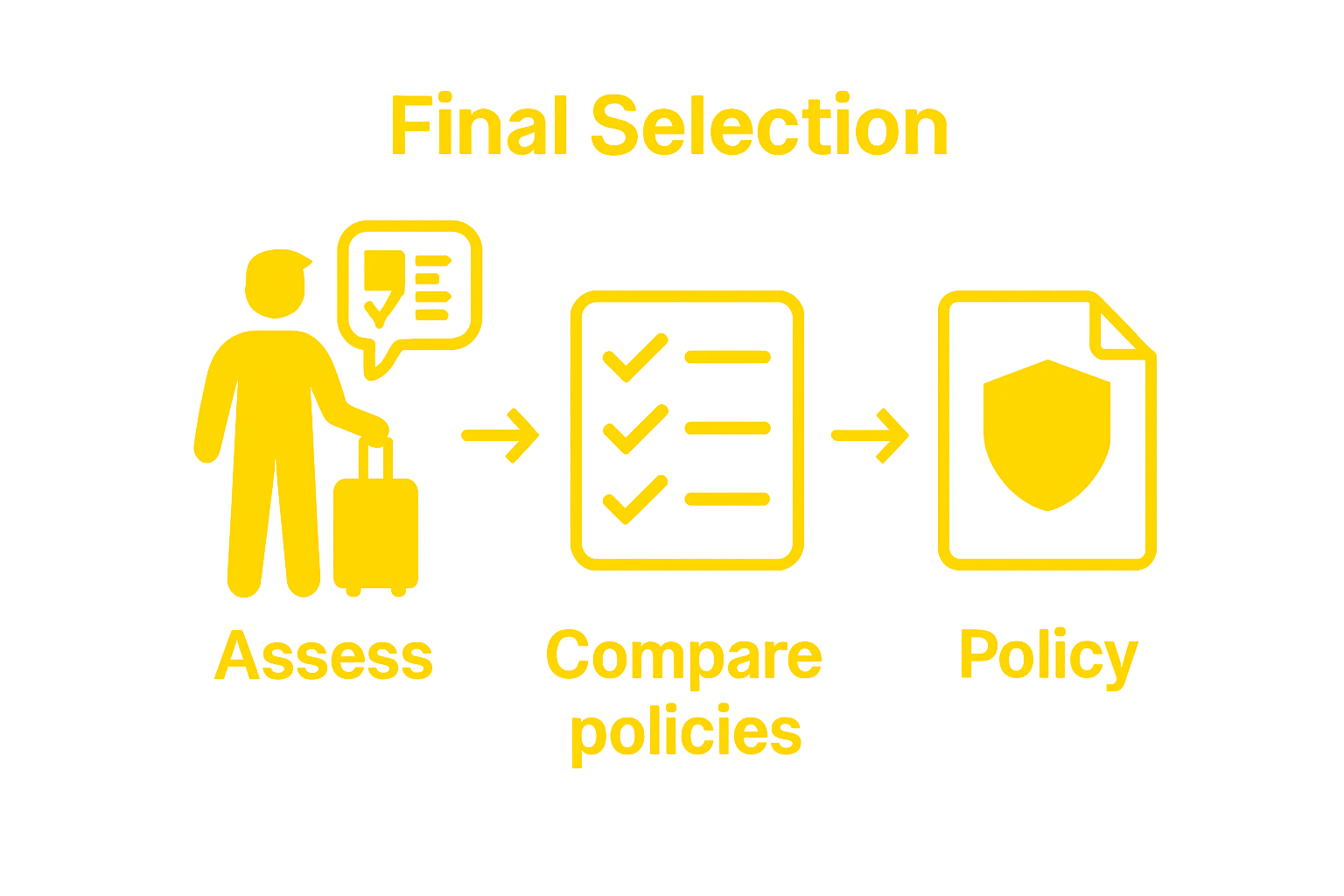 By methodically reviewing and selecting the most appropriate policy, you transform potential travel uncertainties into a structured, manageable approach to personal risk management.

Take Control of Your Travel Protection with True Expertise
Feeling overwhelmed by the process of assessing your risks and comparing insurance providers? If you have ever worried about surprise policy exclusions or struggled to find coverage truly tailored to your health history and travel plans, you are not alone. Many travellers face the same confusion when searching for reliable travel insurance, especially when policies often look similar yet leave crucial gaps in protection. Choosing the wrong cover could put your safety and finances at risk when it matters most.
Discover how Unparalleled Global Benefits can transform this uncertainty into complete confidence. As specialists in expat medical and travel insurance, our expertise ensures your policy is not just a document but a secure safety net designed around your personal journey. Visit our website today to get bespoke guidance and find cover that anticipates every risk and urgency detailed in your research. The right protection is waiting for you now
Frequently Asked Questions
What factors should I consider when assessing my travel risks for insurance?
When assessing your travel risks, consider the duration and nature of your trip, your destination’s healthcare infrastructure, potential regional health risks, your personal health, and any planned activities that may increase risk.
How can I find a reliable travel insurance provider?
To find a reliable travel insurance provider, evaluate their financial stability, coverage options, customer service reputation, and read third-party reviews. Create a shortlist based on comprehensive research rather than just price comparisons.
What key coverage elements should I look for in a travel insurance policy?
Look for emergency medical expense provisions, trip cancellation and interruption coverage, baggage loss protection, medical evacuation services, and accidental death coverage to ensure comprehensive protection.
How can I effectively understand the exclusions and limitations of my travel insurance policy?
To understand exclusions and limitations, read the policy document thoroughly, paying close attention to clauses regarding pre-existing conditions, high-risk activities, and geographical restrictions. Create a checklist to cross-reference your travel plans with potential policy restrictions.
Recommended
-
¿Qué es seguro de asistencia en viaje? Entiende su importancia – Unparalleled Global Benefits
-
10 Essential Tips for Solo Travelers – Unparalleled Global Benefits
-
Understanding Does Insurance Cover Sports Injuries? – Unparalleled Global Benefits
-
Ultimate Vacation Planning Checklist for 2025: US Travelers Guide – Yopki